Following hearings in January this year, the International Court of Justice (ICJ) will next deliver its judgment in The Gambia v. Myanmar. When it does, the Court may finally confront the role that the systematic destruction of a group’s food system plays in a finding of genocide.
The Rohingya case is unusual among genocide proceedings. The most visceral evidence – massacres, sexual violence, and village burnings that began in August 2017 – has inevitably dominated public attention. Beneath that spectacular violence, however, lies a slower, more bureaucratic, and arguably more revealing pattern of destruction, which is the decades-long dismantling of the Rohingya’s capacity to feed themselves.
The Gambia’s application to the Court explicitly invoked Myanmar’s “policy of forced starvation,” including “widespread confiscation of agricultural lands on which the Rohingya grow subsistence crops essential to their survival.” The question now is whether, and to what extent, the Court will give food deprivation the weight it deserves.
Why Food Matters in Genocide Law
The destruction of a group’s food system can be central to a finding of genocide. Article II(c) of the Genocide Convention prohibits “deliberately inflicting on the group conditions of life calculated to bring about its physical destruction in whole or in part.” This provision was drafted in part with Nazi ghettos in mind – sealed communities where food was rationed to starvation levels as a method of incremental death. The Genocide Convention’s drafters originally listed lack of proper food, hygiene, and medical care as examples of inflicting such conditions. They dropped the list from the final text not to narrow the scope, but to ensure no method would be inadvertently excluded.
The international criminal tribunals for Rwanda and the former Yugoslavia have interpreted “conditions of life” expansively, citing subsistence diets and food deprivation as examples. The ICJ itself, however, has never conducted an exhaustive or in-depth analysis of Article II(c). In both Bosnia v. Serbia and Croatia v. Serbia, the Court considered the provision but reached no genocide finding under it, meaning that The Gambia v. Myanmar may be the first case in which the Court engages in depth with Article II(c) in the context of food deprivation.
The Blueprint of Engineered Hunger
A review of the record reveals at least eight interlocking mechanisms through which Myanmar deprived the Rohingya of food: denial of citizenship and land tenure; travel permit requirements; checkpoint proliferation; curfew regimes; camp confinement and aid dependency; confiscation of farming tools; identity document prerequisites for farmland access; and restrictions on humanitarian delivery.
These mechanisms did not emerge in isolation, but fit within the Myanmar military’s (Tatmadaw’s) longstanding “Four Cuts” counterinsurgency doctrine, which aimed to sever food, funds, recruits, and intelligence from targeted populations. Modeled on the British Malayan Emergency counterinsurgency, the doctrine was developed by the Tatmadaw in the mid-1960s under General Ne Win. In the Rohingya context, food appears to have become a primary instrument of control.
At the domestic level, this control began with Myanmar’s 1982 Citizenship Law, which excluded the Rohingya from the 135 recognized “national races” and denied them secure land tenure. Without legal standing, every interaction with the state became an opportunity for extortion – checkpoint tolls, livestock registration fees, fishing permit bribes – draining resources from the beleaguered population. Layered on top was a permit regime requiring documentation for even short journeys between villages, with checkpoints so dense that one refugee described nine in a four-kilometre stretch, and curfew regimes that eliminated peak fishing hours.
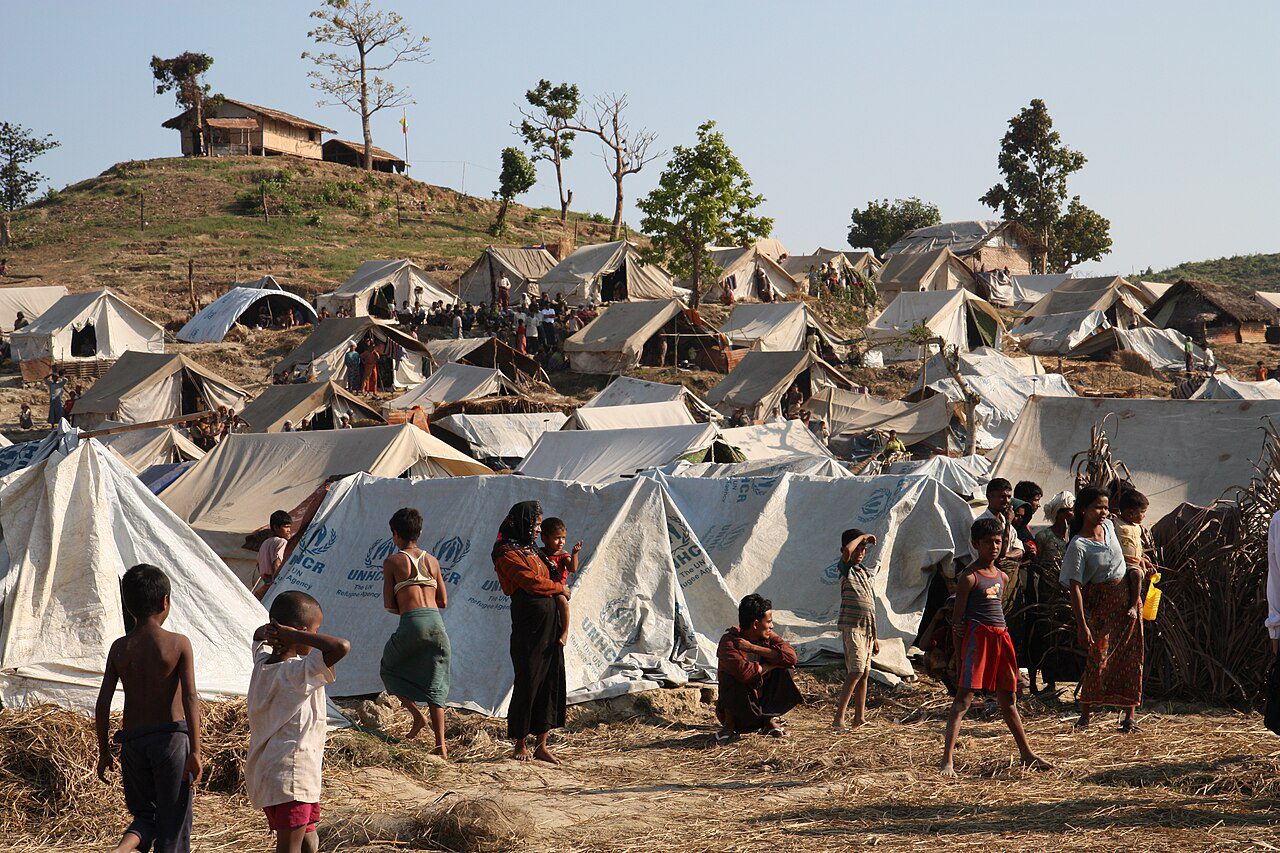
Following sectarian violence in June 2012, over 128,000 Rohingya and others were confined in camps where they became entirely dependent on humanitarian aid that was itself distributed through discriminatory channels and restricted by the state. Markets became inaccessible and remittances were cut off, while the Rohingya could not leave, farm, fish, or trade.
By the time of the 2016-2017 escalation of conflict, the government had confiscated farming implements, imposed identity documents as prerequisites for accessing farmland, and restricted humanitarian organizations from delivering food. In the period surrounding the state’s August 2017 “clearance operations,” the government pressured the UN World Food Programme (WFP) over a food security assessment, published in July, that estimated 80,500 children under five were “wasting” in northern Rakhine’s majority-Muslim areas. By October 2017, after the “clearance operations” had begun, WFP had withdrawn the assessment from public view and replaced it with a notice that the report should not be cited.
From Destruction to Appropriation
The August 2017 “clearance operations” destroyed at least 392 villages, or 40 percent of all settlements in northern Rakhine State. Over 40,600 structures were razed, including marketplaces. Livestock including cattle, goats, and chickens were systematically killed or confiscated, depriving Rohingya both of food and of income-generating opportunities. Some 740,000 people were forced to flee with little to nothing. Screening on arrival in Bangladesh found 145,000 children under five malnourished, with at least 14,000 of them suffering from severe acute malnutrition.
What happened next should be central to the Court’s analysis. Following the mass displacement, Myanmar’s government – through a body chaired by then-State Counsellor Aung San Suu Kyi – systematically harvested and sold crops from Rohingya land. The Rakhine State Minister of Agriculture confirmed that 45,000 acres of “ownerless Bengali land” were harvested, and the Chief Minister stated that proceeds from 70,000 acres of rice paddies would go to the national budget. The land was then leased to ethnic Rakhine farmers and private companies, while the government built “model villages” on confiscated Rohingya land to resettle other ethnic groups.
This sequence – expulsion, appropriation of agricultural output, transfer of land to the national budget and to members of other groups – points to more than counterinsurgency and reflects the systematic destruction of a group’s food-production base and the redistribution of its productive assets. In 2018, amendments to the Vacant, Fallow and Virgin Land Management Act compounded this by creating a legal mechanism to make the dispossession effectively permanent. Rohingya, not being a recognized “national race,” were ineligible to reclaim the very land from which they were expelled.
Ongoing Deprivation
After the mass displacement of some 740,000 people, approximately 600,000 Rohingya remained in Rakhine State under what the Committee on the Elimination of Discrimination Against Women described in 2019 as “conditions of forced starvation.”
In September 2019, the UN Fact-Finding Mission on Myanmar found that the food restrictions “constitute one of several indicators that the Mission has identified to infer that the Government continues to harbour genocidal intent.” The Mission rejected Myanmar’s argument that restrictions were justified by conflict, finding that Myanmar “used movement restrictions and deprived Rohingya of food and humanitarian relief in many different ways and did so long before the conflict . . . intensified.”
Since late 2024, the situation has only worsened dramatically. In November 2024, the UN Development Programme (UNDP) warned that Rakhine State was on the precipice of famine, with over two million people at risk of starvation and domestic food production projected to cover only 20 percent of needs by March-April 2025. UN human rights experts confirmed in March 2025 that the Myanmar military’s near-total blockade of humanitarian aid to Rakhine State since 2023 likely constitutes a war crime. The OHCHR’s latest annual update on the human rights situation in Myanmar, published in February 2026, reported that the nutrition situation in northern Rakhine is projected to rapidly deteriorate to Critical Phase 4 in Maungdaw township and to Catastrophe Phase 5 in Buthidaung.
Food Evidence, Intent, and the “Only Reasonable Inference”
The most formidable obstacle in any genocide case is proving the specific intent to destroy a national, ethnical, racial, or religious group. The ICJ requires that genocidal intent be the “only reasonable inference” from all the evidence. In other words, if another reasonable explanation exists, for example that the conduct was intended to deport rather than destroy the group, then the standard may not be met.
In the Myanmar case, food deprivation evidence carries particular inferential weight for two reasons. First, it demonstrates sustained, centrally directed planning over decades, and at least since the 1982 Citizenship Law. Genocide through mass killing can sometimes be attributed to troops exceeding orders or local actors acting on their own initiative. The systematic construction of a food-deprivation regime – through citizenship laws, permit systems, checkpoint networks, and land confiscation legislation – simply cannot be explained by battlefield chaos.
Second, the post-displacement appropriation directly addresses Myanmar’s most plausible defence. Myanmar has argued at various stages that the violence was directed at counterterrorism or deportation, not destruction. A state that displaces a civilian population, however, does not then harvest that population’s crops, deposit the proceeds in the national budget, and lease the land to members of other ethnic groups, unless the aim extends beyond removal to the destruction of the material conditions necessary for the group’s continued physical existence. That is what Article II(c) prohibits.
Why the Famine Framing Matters Beyond Myanmar
A notable feature of this litigation is that The Gambia channels the food evidence through the “conditions of life” concept rather than the language of famine. The Integrated Food Security Phase Classification (IPC) has never formally classified northern Rakhine State as experiencing famine. Notably, the absence of a formal famine declaration does not mean the absence of mass food deprivation. International law recognizes the deliberate infliction of destructive conditions by their intentionality and their calculable effect, not solely by the degree of suffering actually produced. For purposes of a genocide finding, a formal IPC famine classification could be useful but is not legally required.
This understanding has profound implications for other situations. In Gaza, the IPC has classified parts of the territory at Phase 5, but this classification has been fiercely contested by Israel. If the ICJ anchors its Article II(c) “conditions of life” analysis in formal famine thresholds, it could create a perverse incentive for perpetrator states to obstruct the very data collection that would trigger international legal consequences. If, instead, the Court focuses on the intentional manipulation of the conditions necessary for group survival, it will create a framework that captures how modern food-based persecution works.
Conclusion
The Rohingya never experienced hunger and starvation because of drought or crop failure, but were rather starved through permits and checkpoints, citizenship laws and land acts, the confiscation of farming implements, the suppression of food data, and the harvesting of their crops for the national budget after they were expelled. Such entrenched measures reinforced one another, and the ICJ has a clear evidentiary basis to place food at the centre of its analysis.
A judgment in The Gambia v. Myanmar that focuses exclusively on the killings and sexual violence of the “clearance operations,” without addressing the systematic food deprivation that preceded, accompanied, and followed them, would be an incomplete account of what the Rohingya have experienced and a missed opportunity to establish that the deliberate destruction of a group’s food system may be among the most insidious methods of genocide – through the slow, bureaucratic strangulation of subsistence. Establishing such a framework could matter significantly for understanding state-engineered hunger in Gaza, Sudan, and beyond.



.jpg)