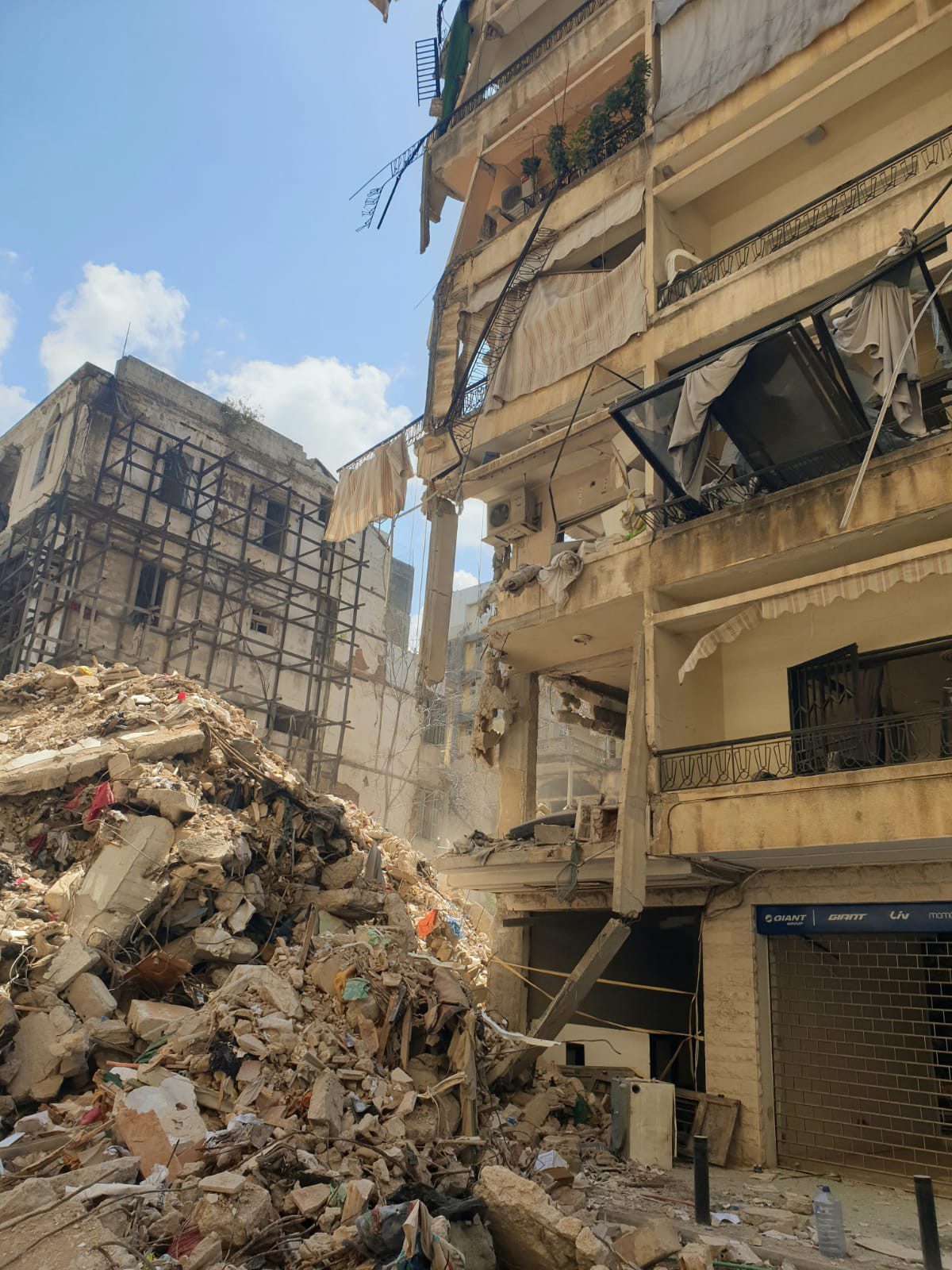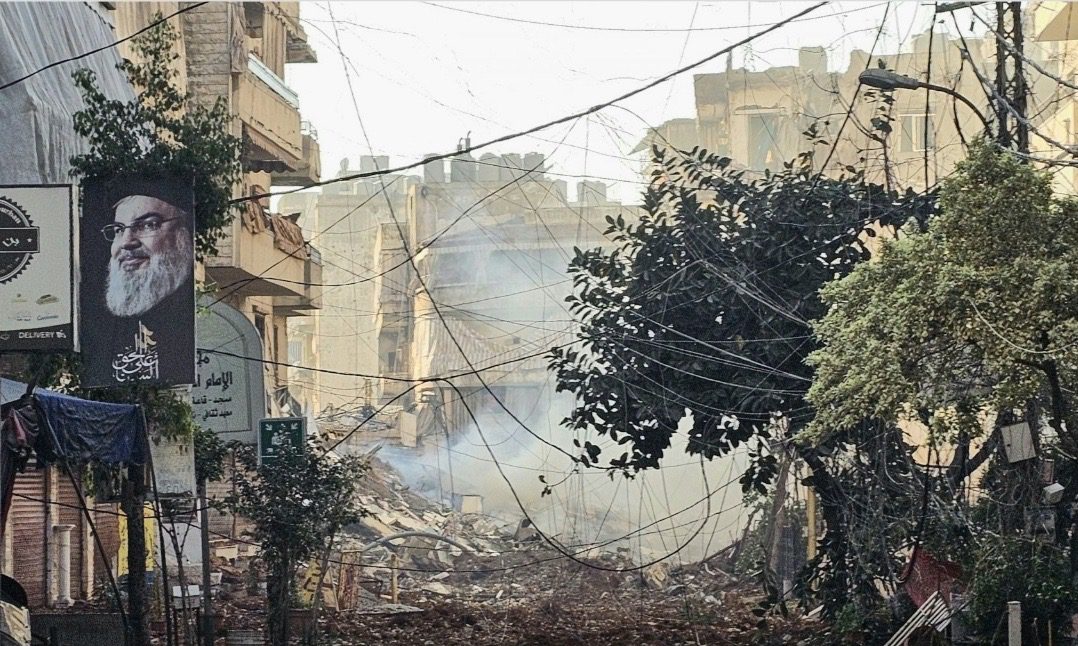
It was 15 July 2006, three days after Hezbollah kidnapped two Israeli soldiers patrolling along Israel’s northern border with Lebanon. Hezbollah called the attack Operation True Promise, the promise of freedom for Samir Qantar, a Lebanese supporter of the Palestinian Liberation Front imprisoned in Israel since 1979. Israel fought back with Operation Just Reward in an ultimately futile attempt to recover its men—Sgts. Udi Goldwasser and Eldad Regev.
I had planned to work a full day in south Lebanon but turned back after an Israeli gunship tracked my car outside the town of Nabatiyeh, flying so low I could see the pilot’s face. He made a gesture that seemed to signify: “Get out of here!” So I did. Once home, all I wanted was a stiff drink. On the drive back I had passed a pick-up hit by a gunship, two young children dead in the back. The pilot must have seen whom he was shooting: he had seen me. But there was a knock at the door. Reluctantly, I opened and found a friend with a young family of his own, sobbing and barely able to speak.
“Do they think we’re animals?” he howled. “Kill the soldiers but not the children! Kill the soldiers but not the children! My sister lives far away, in another continent; she wears blue jeans. My brother too; he likes the Beatles. Do they think we’re animals?”
The worst of them do. “Human animals,” Israeli Defence Minister Yoav Gallant said in October 2023 when announcing a “complete siege” on Gaza. The then head of Israeli military intelligence went even further. Fifty Palestinians had to die for every Israeli killed on 7 October, he said, and “it does not matter now if they are children!”
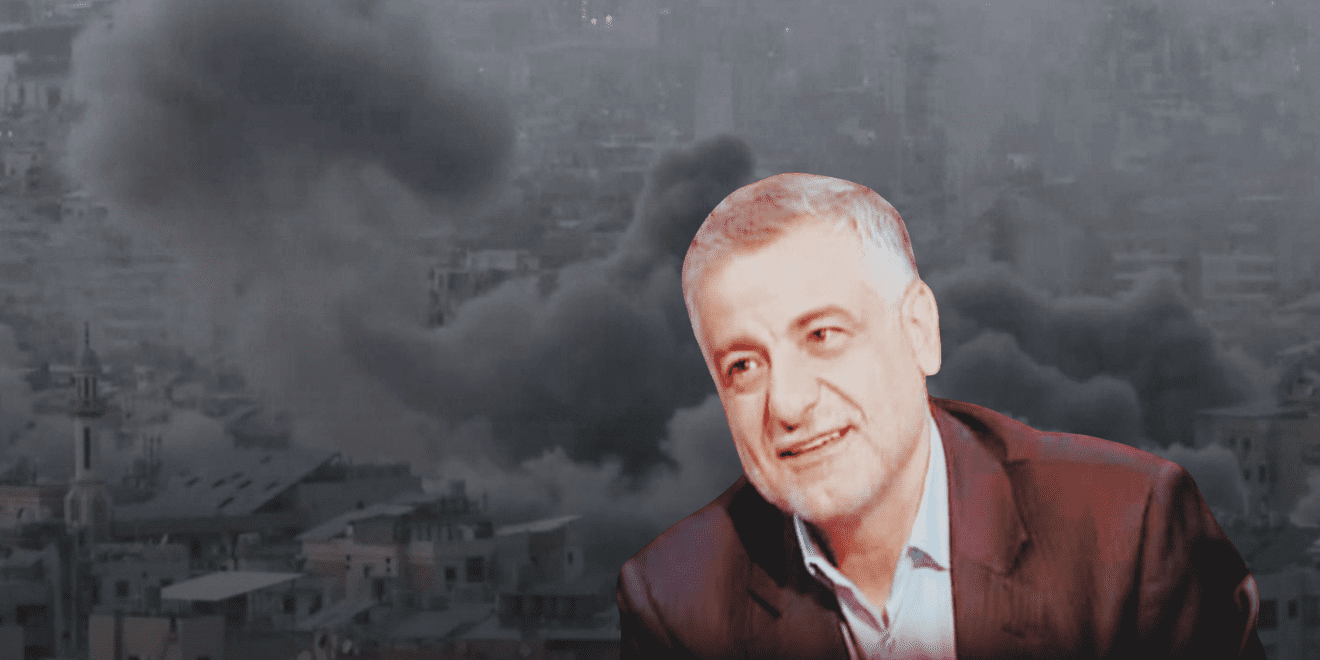
My visitor that evening in 2006 was Mohammed Sherri. Mohammed was killed in an airstrike on his home in central Beirut, together with his wife Amal, on 18 March this year. One of his sons was critically injured. A young granddaughter too.
When we first met, in the mid-1980s, Mohammed was a press officer at the Iranian embassy in Beirut, keen to leave the embassy, move out of Dahiya—the predominantly Shi’a southern suburbs of Beirut that were devastated in the 2006 war—and find work as a journalist reporting primarily on his own community—the Shi’a of south Lebanon. I was working for the Guardian, at a time when interest in Lebanon focussed more on the fate of Western hostages—among them the British journalist John McCarthy—than Israel’s vicious occupation of the south. At the time of his death last month, Mohammed was a programme director of the Hezbollah-affiliated television station al Manar. I had not seen him for 20 years, but I am sure he knew the risks. Already in 2006, as it became clear that Operation Just Reward would not be a matter of just “ten to fourteen days”, the spokesperson for the Israeli Defense Forces had called al Manar a legitimate target against “terror in general”, along with “other grass-roots institutions that breed more followers”. Among them, the IDF spokesperson said, schools.
In the 1980s, the British hostages in Lebanon, unlike the Americans, had disappeared into a black hole. There were no videos, no signs of life. Or death. Just silence. I had met John’s father, the loveliest of men, and he had asked me to do what I could to get news of his son. Here began visits to the Iranian embassy, where I was met by Mohammed, then an awkward, squeaky-voiced young man who reddened easily. But I never got out of the starting gates. Every time I mentioned McCarthy—and his mother, who was dying of cancer—one of the two diplomats I met would bring up Salman Rushdie’s The Satanic Verses, mistakenly asserting that it insulted the Prophet’s wife. So I took a copy of the book to the embassy one day, in a brown paper bag, and the next time it came up, I pulled out the book and said: “If you would permit me…”
One of the diplomats jumped up, spilling orange juice all over me, and ushered me out—by the back stairs. Half way down, we passed an iron door with gratings. I had never been shown out this way before and, more than a little anxious, made a stupid, ill-mannered joke to break the tension along the lines of: “Is that where you’re keeping John McCarthy?”
Outside, in the parking lot, Mohammed exploded. “You need to show respect. You are free to think what you like. But show respect! If you want to continue this conversation, never, ever talk like that again.”
I did want to continue the conversation, and over the years struck up a genuine friendship with Mohammed, despite our different backgrounds. I presumed he belonged to Hezbollah. He said he did not. You could not work for the embassy and belong to a party. Not even to Hezbollah, he said. Like many there, he said, he disliked the taking of hostages like John who had no connection to the conflict in the region. But Hezbollah was the environment in which he lived and moved in Dahiya. He was close to a group of anti-Zionist activists who rejected the state of Israel as strongly as they acknowledged the historic suffering of the Jewish people, and who had started inviting ultra-orthodox rabbis who believed the state of Israel was contrary to Judaism to Lebanon to find common ground. Jewish sovereignty could come only from God, they believed. Not from politicians.
From this small beginning came the Global Campaign to Return to Palestine, which was organized by Hezbollah and its allies in 2013 to bring activists, civil society, and political figures together to support armed resistance as the key to turning the Palestinian “nakba”—catastrophe—into “return”. “The Moslem people were so good to us,” one rabbi said. “They embraced our suffering throughout the exile. We pray every day for a free Palestine. We want it returned to the Palestinian people.”
When Mohammed stepped into journalism, proposing human interest stories, mainly about Shi’a, I gave him my copy of Crimes of War by David Rieff and Roy Gugtman. Read, learn, I said; the laws of war apply to everyone.
Mohammed’s family was originally from south Lebanon, close to the Israeli border, and resistance was in his DNA, as was his passionate solidarity with the Palestinians, who, in the words of the great Guardian journalist and author David Hirst, “suffered a similar kind of statelessness or state indifference” as Lebanon’s Shi’a. On this we agreed. On other things we did not. Among them, my harping on about hostages—albeit for John’s family. “It’s all you are interested in,” he complained one day. He and his friends had something far more important on their minds: chess, which was newly permitted by Ayatollah Khomeini if not for gambling. I played chess; I had covered the Fischer-Spassky championship in Iceland in 1972. He asked if I would show him and his friends some opening moves. I’d get to know them as people rather than pawns, he said. I acknowledged the flash of humour but declined, pleading inadequate Arabic.
One of our strongest disagreements came early in the 2006 war after eight Israeli soldiers died in a battle for the town of Bint Jbeil, a few kilometers from the border with Israel. Bint Jbeil, “the capital of the south”, was a stronghold of the Palestine Liberation Organisation’s Fatahland until Israel’s 1982 invasion to root it out. Today, exactly 20 years after Operation True Promise, it is once again at the center of Israel’s push through the Lebanese mud that has entrapped its soldiers time and again despite the license given them. As spelled out by General Gadi Eisenkot, former chief of Israel’s Northern Command, in 2008: “What happened in the Dahiya quarter of Beirut in 2006 will happen in every village from which Israel is fired on. … We will apply disproportionate force on it and cause great damage and destruction there. From our standpoint, these are not civilian villages, they are military bases… This is not a recommendation. This is a plan. And it has been approved.”
Early this month, Israeli Defense Minister Israel Katz made clear that Eisenkot’s “plan” is still unfolding: “Homes in villages near the border in Lebanon, which serve in every respect as Hezbollah outposts, will be demolished in accordance with the Rafah and Khan Younis model.”
Mohammed was not a fighter, but he had heard what had happened in Bint Jbeil and was jubilant. “The resistance pulled back as the Israelis approached. Our men hid. Behind doors. Underground. The Israelis came in, found the place empty, threw their weapons down and started cheering: ‘The cowards ran away!’ Then our men came out and shot them in the back as they ran away.”
I found his pleasure shocking and told him—incorrectly, I now know—that shooting men in the back as they fled was against the rules of war. It was also plain cruel. It lacked the compassion he showed at other times for the Jewish people. I told him how, some 20 years earlier, I had been captured by an Israeli foot patrol while driving in south Lebanon. “Maybe you are terrorists” they said. “They use women—and children!” These young soldiers had no idea where they were and, wherever it was, they did not want to be there. They wanted to be back in Israel, dating and eating hummus—just like the Lebanese. They were terrified in this strange land and, terrified, lashed out. A car came down the hill toward us and its occupants were captured too. They were armed. One of the Israelis kicked them in the genitals. Another turned his face away. “Oh shit! Oh shit!” he said. “I don’t like this any more than you. But I’m young and I want to get out of Lebanon alive!” A second car approached, with a child clearly seated beside the driver. The sniper in the patrol opened fire, and the child disappeared from view, shot between the eyes.
The child, not even in his teens, was not a “terrorist”. He was on his way to a family wedding. His sister was wearing ragged blue jeans, before ragged became fashionable, and cheap gold shoes.
Soon after, the little boy was lying on the back seat of my car, unconscious. I held a knife between his teeth to stop him swallowing his tongue as the patrol medic thumped his chest to start his heart beating, trying to keep him alive.
As you have your differences, so do they, I told Mohammed. Do not paint them all with the same brush. But Mohammed, witnessing yet another IDF assault on the south, had no sympathy for Israelis like these. “If they do not want to die in Lebanon, let them go back to their own country!” he said. “To hell with them! If we let them live, they will come back to take our land. This land is ours. Not theirs!”
In 2026, some Israelis on the far right are reviving, forcefully, early Zionist claims to swathes of Lebanon as part of Eretz Israel, a “greater Israel” encompassing all of Mandatory Palestine as well as parts of Jordan, Syria, and Iraq. “We must conquer territory in southern Lebanon, destroy the villages there and annex the territory to the state of Israel,” Zvi Sukkot, a member of the Knesset for the Religious Zionist Party said last month.
Shamefully, today, extrajudicial killings like Mohammed’s are euphemistically named “targeted strikes,” and the language of reconciliation and diplomacy has been replaced by that of genocide and hatred. This is not just in Israel but also at the highest levels of US government, where War Secretary Pete Hegseth has laughed off “stupid rules of engagement” in favour of “overwhelming and punishing violence… to intimidate, demoralize, hunt and kill the enemies of our country… and destroy them as viciously as possible from day one.”
It is impossible to know what will emerge in the region—even what will be left of the region—as a result of this war unleashed not just on the hydra that is the Iranian regime, but on the Iranian people. And on Yemen, Syria, and Iraq as well as Lebanon. For President Donald Trump, one size fits all. All are “terrorists”. For the moment, he will keep bombing his little heart out—his words, not mine—“just for fun”.
Only one thing is sure: whoever comes out on top, and whatever the final justification for a war openly declared to be waged by war crimes, there will be no “victor” in the new regional order that will emerge from the ruins of a conflict built on untruths and plastered with complete disregard the rules of war.
Two things, however, seem probable.
First, without unprecedented and mighty Western opposition—in deeds rather than devalued words—it is likely that Israel will occupy, perhaps even annex, ultimately, a large part of south Lebanon, at least as far as the Litani river, developing, through blood and tears on all sides, the Eretz Israel dream mapped out by Israel’s first president, Chaim Weizmann, and its first prime minister, David Ben-Gurion, at the Paris Peace Conference that ended World War I. Trump, who could stop Israel, cares nothing for the neglected, impoverished southern Lebanese, men, women and children, old and infirm, who are at the sharp end of a war that will haunt the United States for years to come.
Secondly, sectarian divisions in Lebanon, already newly straining, may reach a breaking point as the gap widens between a strong, determined, unrepentant Hezbollah and its opponents.
In recent years, Hezbollah and its supporters in the resistance have seen negotiations undercut, time and again, in Washington and Tel Aviv. “Where,” they ask, “were the leftists, the communists, the people who care about human rights when we heard children crying in Gaza two years ago? They all disappeared. Now those children are dead! The system of international justice set up after the world wars collapsed when it came to Israel, which only understands the language of war. What is the point of talking at this point? We will fight to the end—and we will win.”
Much of the acceptance that Hezbollah won in some quarters since its emergence from Israel’s 1982 invasion and brutal 18-year occupation of south Lebanon came from the insistence of its secretary general, Hassan Nasrallah, that its objectives were strictly national, Lebanese objectives. Hezbollah, Nasrallah insisted, was no-one’s “proxy”. But the party stepped outside these boundaries in 2011 when it entered the Syrian civil war on the side of President Bashar al Assad, Iran’s other major ally in the region. Its fight for the brutal Assad regime, won it the hatred of many of Lebanon’s Sunnis.
Then, in October 2023, Hezbollah’s support even among some of its own base wobbled, momentarily, when it launched rocket and artillery attacks on military positions in northern Israel in “a limited operation,” Nasrallah said, to divert assets from Israel’s genocidal war on Gaza. Almost 100,000 southerners were displaced. Most returned, despite the devastation. Now Hezbollah’s decision to support Iran in what Tehran’s clerical regime sees as an existential threat is costing it further support among more than one million displaced southerners who fear that, this time, there will be no return. Israel has not hidden its determination to make their towns, villages and farms “inhabitable” for the Lebanese.
Hezbollah had said that its red line for staying out of the Iran war was an attack on the country’s Supreme Leader, Ayatollah Ali Khamenei. A week later, Khamenei was assassinated.
As it moved away from its early support for an Iranian-style Islamic revolution, Hezbollah became a political party with members in Parliament and ministers in government. Nasrallah, whom many saw as a voice of moderation within Hezbollah, was extrajudicially executed by Israel on September 27, 2024. In a worst-case scenario, Hezbollah may now return exclusively to its guerrilla roots. Prime Minister Nawaf Salam has already ordered a nationwide ban on its military activities. That ban could be extended to Hezbollah’s entire structure if political disputes within Lebanon turn to violence, as many fear they will.
It is impossible today to see the road out of this ever-widening conflict that was launched, allegedly, to stop Iran from acquiring the nuclear bomb that Israel already has. “We negotiate with bombs,” boasts Hegseth. But peace is built on negotiation and compromise. Not bombs. What is certain is that, with most Western governments showing no moral compass and Iran and its allies fighting for their very survival, what is left of the road will be drenched in blood.
Mohammed is one of five journalists killed by Israel in its latest, month-long, and, as yet, unfinished Lebanon war—despite the theoretical protection of international law, which makes targeting journalists a war crime, regardless of their political affiliation or whom they work for. Others have been injured. Media outlets have been struck. Crews have been obstructed and ordered away—under threat of death if they don’t.
At least my friend will not be here to see how this tragedy ends. I use the word “friend” advisedly—stubbornly—remembering the support that Mohammed gave me in the horrible days of hostage-taking. In Beirut by chance in March, I heard the blast that killed him and his wife. I had not seen him for 20 years. On television, he had become a consummate, calm interviewer. Too calm, for some. Challenging, but never impolite.
In an unusually plain, very personal tribute, colleagues remembered his “kindness, refined character, and genuine humility”. On screen, they said, “he engaged in dialogue and debate, shaping the framework of media resistance within the bounds of objectivity, ethics, and the pursuit of common ground.” “Truth in everything was a principle for Mohammed Sherri,” another said. “He would say that the resistance possesses enough achievements, victories, arguments and narratives that it does not need to build its standing on inaccurate information or fabricated stories.”
Everyone changes, in some way, over 20 years. But there is one thing I am sure of; Mohammed’s message to those who are rejoicing in breaking every rule of war, while promising worse to come, would be, as it always was: “Kill the soldiers—but not the children.”