All recent famines are associated with war, genocide, or both. The number and lethality of wars closely parallels the incidence and gravity of war-related famines, as demonstrated in this blog post.
As an earlier blog post shown, famines triggered primarily by natural calamity or economic adversity have entirely disappeared from the world, with the last country not at war to suffer famine was North Korea in the 1990s. Today, violent conflict overwhelmingly dominates famine causation. We found that when a country reaches a level of GDP per capita equivalent to $1100 (constant 2011 US $), it is no longer vulnerable to climatic or economic shocks causing great famine, defined as a famine that kills 100,000 people or more. This can also work in reverse -– when war impoverishes a country, it may plunge below the $1100 GDP per capita level and become vulnerable to famines triggered by natural calamity or economic shock. Syria and Yemen are obvious cases.
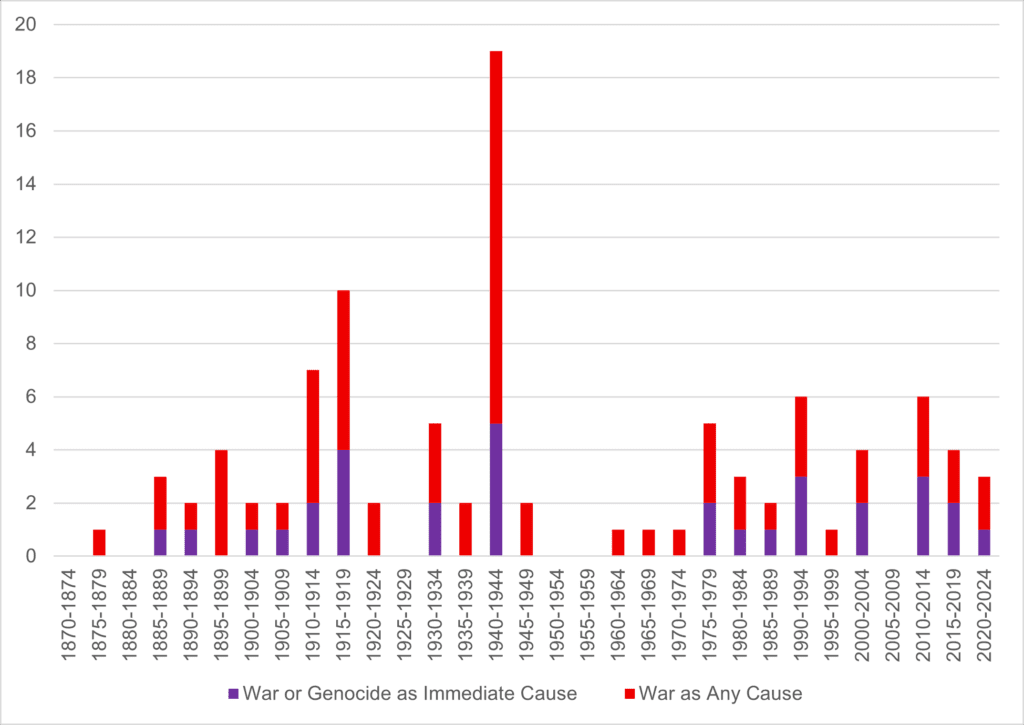
To show how wars and famines move together, let’s start by tracking the number of great famines by the date when they began. Famines here are coded by war or genocide as the immediate or sole cause, or those with war as a contributing cause. Here’s the trend over 150 years:
Figure 1: Numbers of War-Famines Since 1870
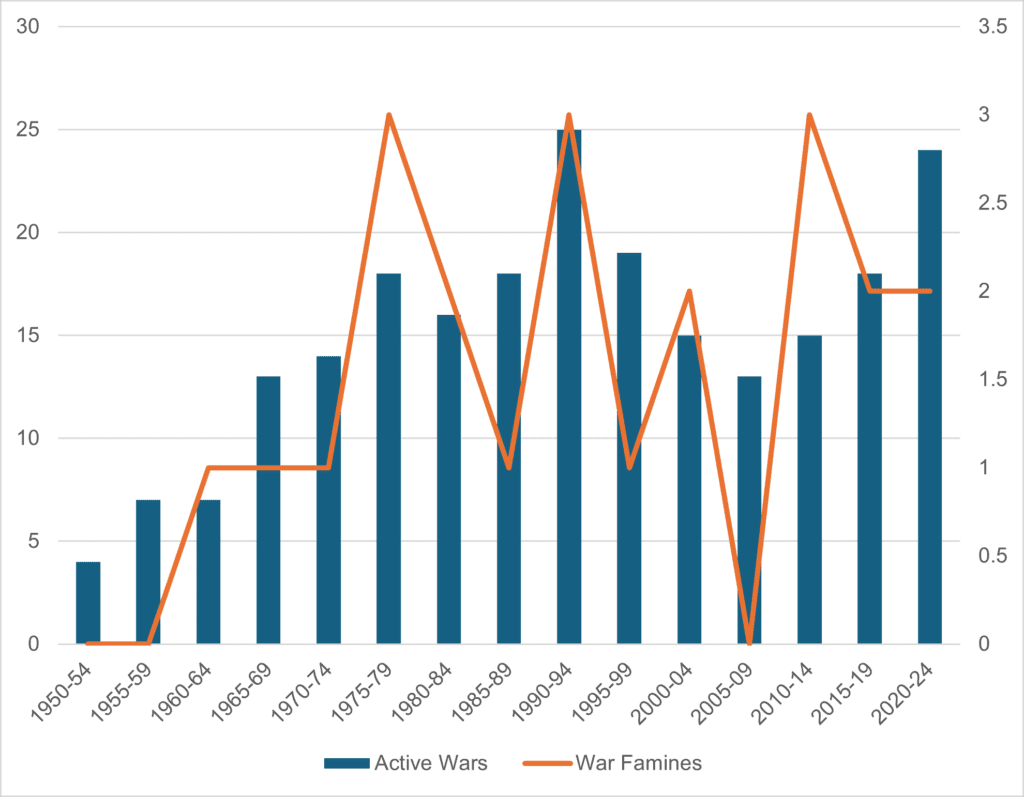
Now let’s see how the trends since 1950 map in comparison to data for the numbers of wars. Here we use the Correlates of War (CoW) dataset, which has a threshold of 1,000 battle deaths. The chart shows ongoing wars and war famines (all causes) in an aggregated five-year period. What it shows is that about one in ten ongoing wars create a great famine, directly or indirectly.
Figure 2: Active Wars and War Famines since 1950
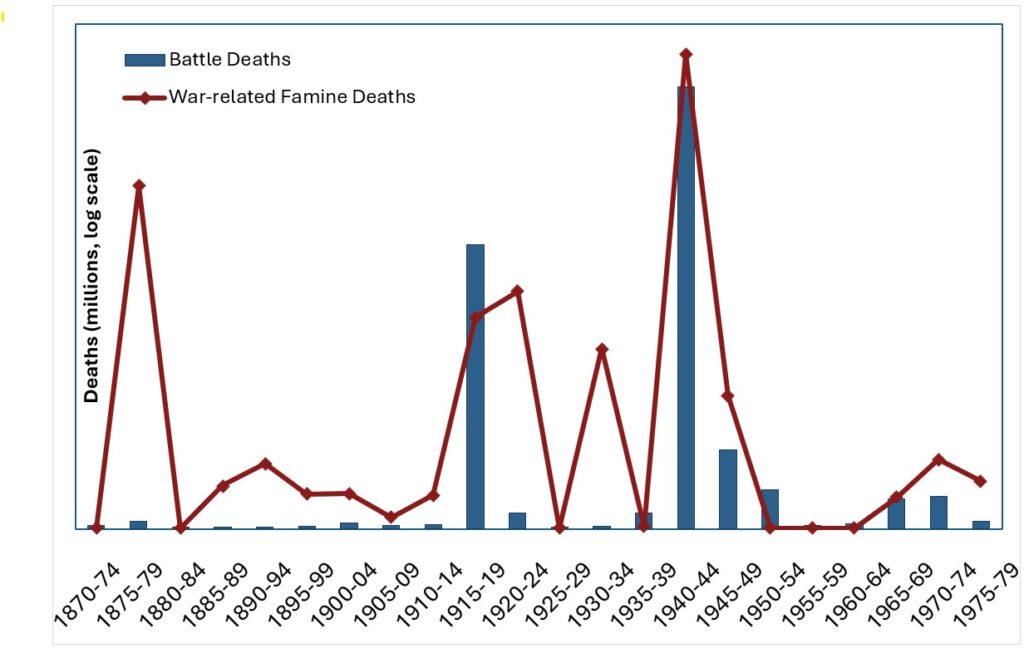
When we turn to the death toll in war-related famines we see two distinct patterns relating to different historical periods and geographies. During the decades from the 1870s to the 1970s, the epicenters of major wars and war or genocide famines were Asia and Europe, with much lower levels of both in the Middle East and Africa. Over these decades there is a clear association between battle deaths and war-famine deaths, insofar as they share massive peaks during World War One and World War Two. But outside these huge spikes, the association breaks down. This is partially because there were two huge genocidal famines – Ukraine and Kazakhstan in the early 1930s, Cambodia in the late 1970s – that weren’t directly linked to war. But what we also see is huge spikes in famine deaths in colonial Africa, where battle deaths were fewer (and harder to obtain, so perhaps not fully recorded in the CoW dataset), and in the Chinese turmoil of the warlord era, while some of the major wars of the era, such as Korea and Vietnam, had huge battle deaths but are not recorded as having caused mass starvation. In the figure, some of the correspondences show different parallel patterns – the famines of the late 1940s were in the Soviet Union, still afflicted by the aftermath of World War Two, while the ongoing wars were in Asia.
Figure 3 shows this. The data are presented on a log scale to take account of the power-law effect, which is that a few huge events are orders of magnitude greater than others.
Figure 3. Deaths in wars and war-related great famines 1870-1979
From 1980 onwards, the geography shifts to Africa and the Middle East – plus the Ukraine war. While there isn’t a match between the highest battle death counts and the highest famine deaths – notably the Ukraine war hasn’t seen mass starvation fatalities – the overall correspondence is clear:
Figure 4. Deaths in wars and war-related great famines 1980-2024
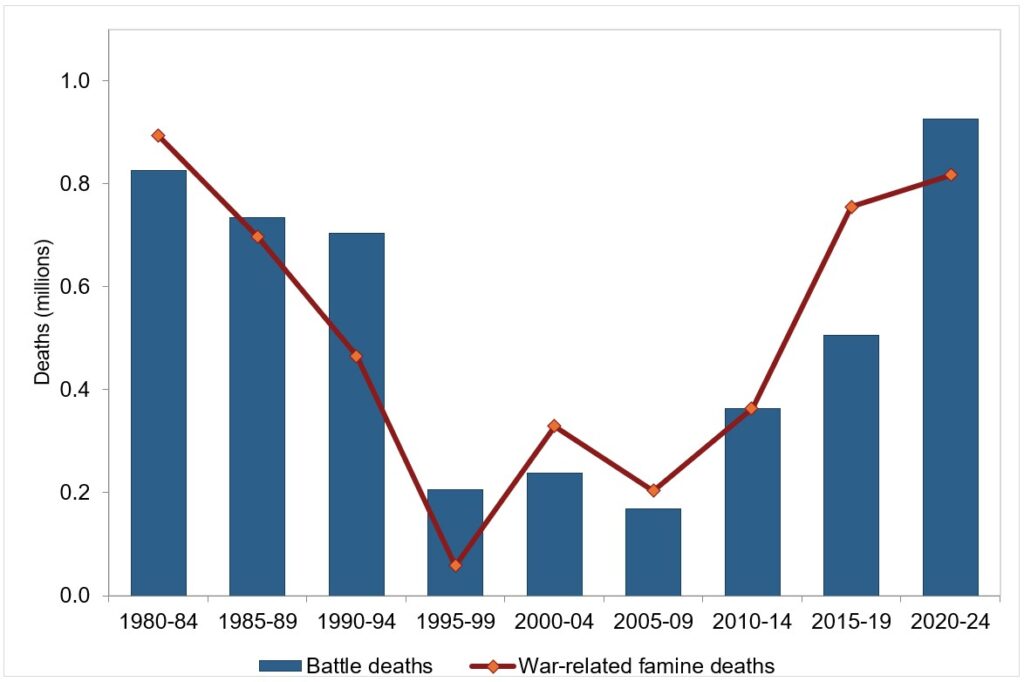
Note that war deaths and famine deaths are on the same scale – i.e. the number of people dying from war and in great famines is about equal. The dataset doesn’t include famines that killed fewer than 100,000 people, though there are many. If we were to include famines of a lesser scale, we would see many more deaths from hunger, disease and cold.
In every war, these types of excess deaths exist. The ratio of trauma deaths (in battle or direct violence against civilians) to non-trauma deaths varies widely, with a median figure from multi-country study of 1 trauma death to 1.19 non-trauma deaths. Most of this excess non-trauma mortality would qualify as ‘famine’ as it is epidemiologically associated with malnutrition and the destruction or deprivation of objects in dispensable to survival.
Nothing in this blog post should be surprising. It merely underlines what scholars and practitioners have been saying for years. The only surprising thing is that the elementary association between war and famine still comes as a surprise to so many.