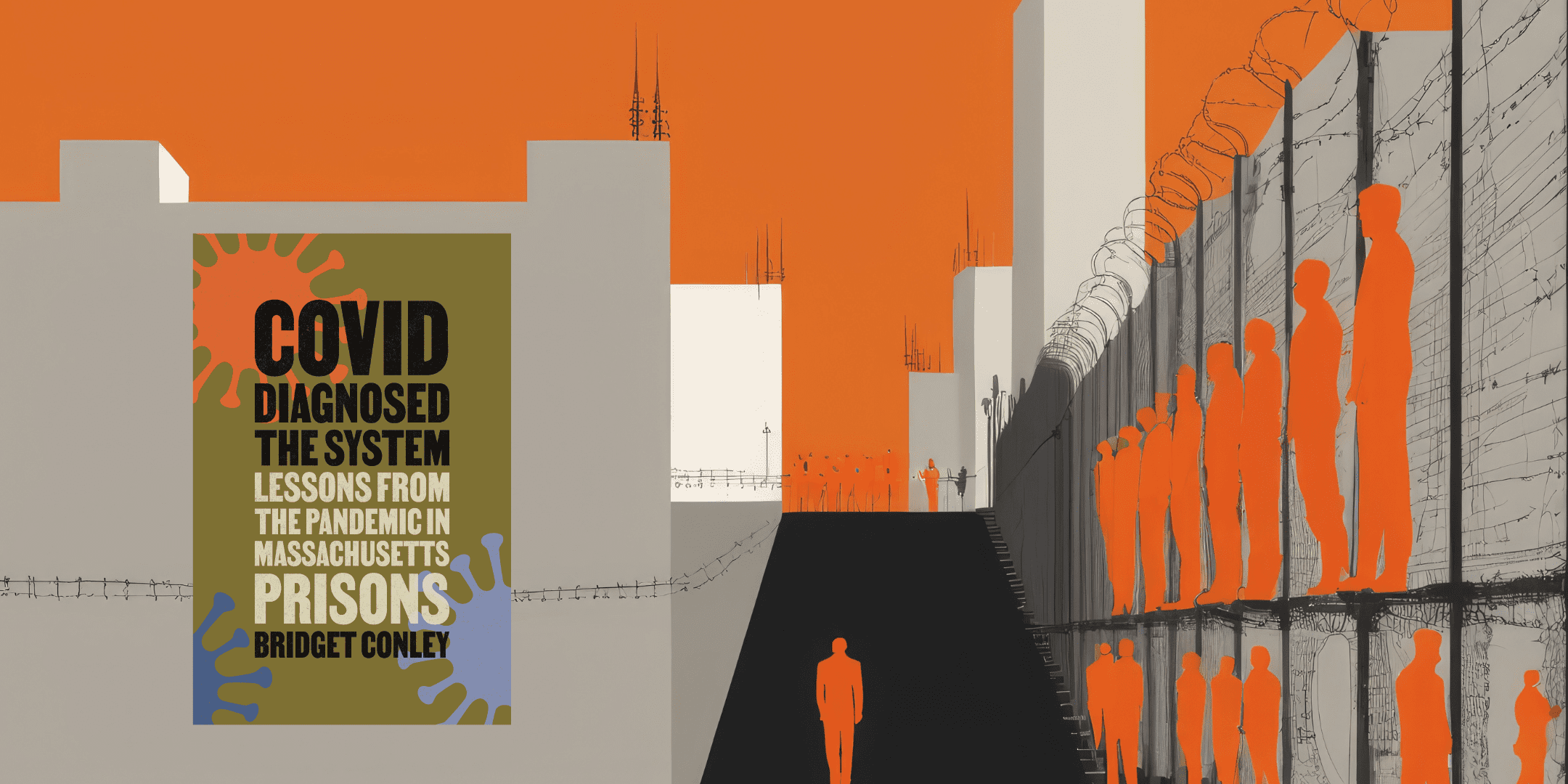
This is the second of a series of essays on the ideas and stories from my book, COVID Diagnosed the System: Lessons from the pandemic in Massachusetts’ prisons (Rutgers University Press, 2026). The first essay can be found here. All quotes below are from the book, unless otherwise indicated.
—–
My account of the story of the pandemic in Massachusetts’ prisons begins where COVID-19 began, in China in late 2019. From this starting point, the book’s narrative then quickly turns to the pandemic in Massachusetts prisons, highlighting a key legal case brought to the state’s Supreme Judicial Court in late March, as the criminal justice system was transitioning to remote practices. It follows trends of infection and death during the first wave in Spring 2020, and then the second wave that began in Fall 2020 and continued into January 2021.
In this essay, I’ll provide an overview of key events and issues that emerge through study of this time period. The book argues that prisons and other detention centers are central to any historical account of the pandemic itself:
No history of the COVID-19 pandemic is complete without detailing what happened inside prisons, jails, and other detention centers. From the start of the pandemic in China and everywhere the virus spread, it was always and everywhere a prison story. In the United States, home of the world’s largest population of incarcerated people, detention centers were central to the national pandemic story. To illustrate, between March 2020 and August 2020, ninety of the 100 largest COVID clusters in the U.S. occurred in prisons and jails. Given the country’s addiction to incarceration and the threat posed to people living in congregate housing, prisons were not a marginal or specialized area of pandemic concern. If you want to understand the pandemic in the United States, you must examine detention centers (1).
The centrality of prisons to the pandemic story was evident within weeks of the first outbreaks in China. During the crucial days and weeks before the Chinese epidemic riveted concerns, and before it became a global pandemic, prison outbreaks shattered the Chinese government’s narrative that it was beginning to gain the upper hand against the virus:
…by mid-February [2020], the Chinese government reported indications that the massive quarantine effort was beginning to pay off. Mi Feng, National Health Commission spokesperson, opened an afternoon press conference with positive news, suggesting that the tide was turning. As the Associated Press reported, “Mi Feng said the situation is still grim but ‘we have seen some positive changes.’”
Behind the scenes, another story was playing out. As a later Chinese government investigation would reveal,[i] before Wuhan locked down on January 21, a person left the city and traveled 720 kilometers north to Jining city in Shandong province. In Jining, this person interacted with several others who worked at the Rencheng Prison. Not long afterward, on February 12, a prison guard started coughing. He was isolated and then admitted to a medical facility for treatment, where he tested positive. Later that same day, another guard tested positive. Two days later, close contacts of these guards were isolated, and areas where they had lived and spent time were closed and disinfected. On February 15, officials conducted a first round of comprehensive testing of guards, other staff, and incarcerated people. A second round of testing began on February 20, which revealed a massive outbreak at Rencheng Prison.
On February 20, 2020, at 9:51 a.m., the People’s Daily, a government-affiliated news source, tweeted an update shattering the government’s narrative that conditions were improving: “Rencheng Prison in Shandong Province has reported 207 confirmed cases of #COVID19, 200 of whom are prisoners, as of Feb. 20. Xie Weijun, the provincial judicial department chief, was removed from his post.” The news got worse. That same day, the Chinese government reported prisons in three provinces had outbreaks. In addition to Rencheng Prison, there were now four other outbreaks: 230 confirmed positive cases at Wuhan Women’s prison; 41 at Shayang Hanjin Prison in Hubei Province; and 34 positive cases at Shilifen Prison in Zhejiang Province, which is over 550 kilometers east and slightly south of Wuhan. The fifth prison experiencing an outbreak was not identified. In subsequent days, the toll in prisons climbed even higher. “Jails in China,” as Business Insider reported, “are the new frontier for the coronavirus” (27 – 28).
As the virus spread around the world, prison officials around the world adopted a similar prison policy playbook (lockdown, cleaning, masks). However, there were significant variations that reflected localized social and political expectations. China, for instance launched criminal charges against prison administrators who failed to scrupulously follow guidelines and implemented harsh labor requirements for prison guards. Italy experienced a large-scale prison riot that ended only with promises of free skype calls, so incarcerated people could remain in touch with their loved ones. Several countries, including Belgium, the UK, Norway, Iran, Turkey, among many others, “decarcerated” – that is, used largescale releases to lower the numbers of people held within detention sites.
Nowhere would pandemic detention policies be more consequential than in the country with the largest population of people held in detention sites: the United States. The toll of sickness and death inside American carceral institutions reflected both the scale of detention, and socio-political acceptance – and even embrace — of harsh carceral conditions. To illustrate, by April 2021, the end of the first year of the pandemic, as a team of epidemiologists reported: “infection rates inside U.S. prisons were 45 percent higher than among the general population, and prison mortality rates increased 77 percent in 2020 as compared to 2019, which was 3.4 times higher than the increase among the general U.S. population. These detention hot spots also had spillover impacts, with studies documenting high rates in areas near prisons and jails” (145).
Massachusetts, which has one of the country’s smallest populations of people in prison and lowest incarceration rates, was hit hard and early. Nonetheless, of its 16 operational prison sites (at the time), only three had significant outbreaks in Spring 2020: Massachusetts Treatment Center, MCI-Framingham, and MCI-Shirley. Despite this relatively low number of outbreaks, a team of epidemiologists found, that “the rate of COVID-19 among incarcerated individuals was nearly 3 times that of the Massachusetts general population and 5 times the US rate.” Additionally, the DOC attributed 8 deaths to COVID during this first wave. This is a large number for this prison system, which had experienced an average of 2.8 deaths per month over the period 2015 – 2019 – during which time the population decreased from 10,118 to 6,848 (101). What is more, in April 2020 alone, 14 incarcerated people died, a shockingly high number in this context. My research suggests possible contributions: COVID (certainly), but also “increased stress, meals that did not align with dietary restrictions, interruptions in access to daily medications, and lack of attention to non-COVID medical needs” (102).
In speaking with directly impacted people, one can also discern a series of actions taken by prison administrators that likely contributed to outbreaks. Among these are: not taking the virus seriously at the beginning; moving people to different housing units based on their symptoms (when it was already clear that asymptomatic people could be contagious); lack of a coherent communication plan; and medical quarantine procedures that adopted punitive isolation practices, like limitations on ordering from canteen, limited access to showers, and lack of access to personal materials (reading, change of clothes, etc.), which dissuaded people from reporting symptoms. Granted, conditions were fastmoving and unprecedented, and the DOC adopted some efforts to mitigate the isolation, like two free 20-minute calls per week.
However, despite the spring outbreaks and death toll, there was no review of the prison system’s handling of this first wave of the pandemic (at least not any that was made public) and no accounting for the excess deaths. The prison system was simply given a free pass. The stakes of lack of accountability became clear during the deadly Winter that followed.
By the second wave of Winter 2020 – 2021, almost all prisons experienced serious outbreaks. We know this because of the court-ordered releases of data related to testing, positive cases, and – although not until the summer 2020 – deaths. Throughout the book, I critically probe the COVID data produced by the DOC. It was poor – as was that of most prison systems in the country. A nation-wide ranking of the quality of prison COVID data gave the state a grade of “C” for its work. Despite significant questions – some of which are addressed below – the data made clear that pandemic inside prisons in Winter 2020 – 2021 was brutal. As stated in the book:
“…from October 2020 through February 2021, five prisons had test positivity rates in the double digits: MASAC, Gardner, MCI-Concord, MCI-Framingham, MCI-Shirley, and SMCC (Table 5.2). Positivity rates examine the number of positive cases in relation to the total number of tests. Because the amount of testing itself was an issue, I included the number of positive tests relative to the total population of prisons. This is likewise an imperfect measure, as we do not know how many people were tested more than once or not at all. All the data should be treated with caution and as partial descriptors of conditions. Nonetheless, the numbers indicate that by the end of February 2021, twelve Massachusetts prisons were inundated with the virus. (128 – 129).
Several challenges existed with the DOC’s data. For example, in some weeks, there are more positive cases than are tests administered. The DOC has explained that mobile testing units were used, but the number of such tests administered was not recorded, while the number of positive cases was. This gap along with others, like information about whether everyone was tested, or if only a portion of the population was tested multiple times, limit what can be understood from the testing data.
There were also issues with the DOC’s reporting on deaths during this period. Unlike testing, death is definitive. Further, in this relatively small system, the number of deaths – according to the DOC, 21 people died of COVID-related causes — was not so high that it should be difficult to determine the facts around each. One would expect accuracy. Nonetheless, there are discrepancies between data released by the DOC through a public records access request and that required by a court order and released to an appointed Special Master. The discrepancies concern the cause, location or date of six deaths during the period studied.
Additionally, the DOC granted medical parole decisions at least three times, as the incarcerated people were intubated and alone, dying in a hospital. A medical parole decision, granted under the authority of Superintendent Carol Mici, meant that the person is no longer in custody. It doesn’t count on the DOC’s record. The practice was never investigated by anyone with full access to DOC records, so while three cases are documented by a journalist and an attorney, it is unclear how widespread the practice was. Several of those released on medical parole who did not die were re-arrested, including an elderly man within two months of his normal parole date, who was so weak and fragile that he had to be assisted down the front stairs of his house on his way to back to prison.
Beyond data issues, the overall picture of COVID response is that of a system that approaches everyone inside as not deserving basic human rights, respect and the possibility for change. People in prison are disproportionately Black and brown, from poor and under-resourced neighborhoods. They are also disproportionately people who have experienced violence and harm before they committed a harm (if they are guilty of doing so, which is far from the case for everyone, see the New England Innocence Project). People who have experienced child abuse, suffer from addiction, spent time in the foster care system, suffered domestic abuse, were previously victims of crimes, and those with mental health illnesses or post-traumatic stress syndrome all experience high rates of incarceration. In this way, “victimization and perpetration of crime are not opposites. They are too often snapshots in time from the life of a single person” (74). Once incarcerated, however, people are treated solely as perpetrators, who require coercive control. Given this structural posture and the lack of accountability for policies inflicted within prisons, COVID, as is argued in the title of the book, diagnosed the fundamental inhumanity of the prisons system, per se.
The historical timeline of the book ends with the administration of the vaccine inside the prisons, with the first dose in January and the second in February 2021. Smaller outbreaks and shorter periods of lockdown continued thereafter, but not with the same overall volume or impact. The final chapter addresses what now can be said about what the DOC and larger system did and did not do to mitigate the impact of the virus. Some important measures were undertaken – like free phone calls, video calls (although people were stripped searched before and after such calls illogically keeping a dehumanizing policy intended for in-person visitation), and use of medical parole (140 – 144). But the overall picture is that pandemic conditions “amplified the enduring brutalities of carcerality” (145).
My assessment agrees with that found in other studies of the impact of COVID-19 on incarcerated peoples’ lives – like Victoria Law’s Corridors of Contagion: How the pandemic exposed the cruelties of incarceration, and Hadar Aviram and Chad Goerzen’s Fester: Carceral Permeability and California’s COVID-19 Correctional Disaster, and Veronica L. Horowitz, Synove N. Andersen, and Jordan M. Hyatt’s work on the “new pains of imprisonment” — that the pandemic magnified the physical and mental health risks, social isolation, and punitiveness of America’s carceral addiction. As Horowitz, Andersen and Hyatt write: “the pandemic magnified the subjective painfulness of imprisonment exponentially. Existing pains were amplified (or became more severe) and/or diversified (taking on new forms or sources), while new pains of imprisonment developed. We use ‘compounded,’ to emphasize how interactions between distinct co-occurring pains magnified the impact of one another” (89).
COVID did not create these pains, it diagnosed the system in which such pains are ever-present. As Leslie Credle, who is today director of Justice 4 Housing, and who is formerly incarcerated told me: “What COVID did is it shed light on situations that are already happening. It’s not anything new…only thing it did was put a spotlight on prisons and make the public aware of what was happening where people ignored it because they felt like all these people committed crimes, who cares what they’re doing to them in there?” (2 – 3).
When Leslie first said this to me, many years ago, it changed the trajectory of my analysis. But I would argue that her work and the work of many other directly impacted social justice activists in Massachusetts were crucial to making sure that spotlight would focus on prison conditions, and to changing what is understood about prisons and what is needed to create safer and more vibrant communities. The book has two major arguments: first, as discussed in this essay, is that prisons (among other detention settings) were central to the story of the pandemic. The second is that the prison story cannot be reduced to the harms of COVID and that changing it requires treating the analysis, testimony and insights of directly impacted people as expertise. I’ll address this point in my next essay.
[i] Jun Wang, “The Case of 207 Confirmed Cases in Rencheng Prison Has Been Clarified, and the Ministry of Justice Requires a Major Rectification of the Prison,” Beijing News, March 4, 2020, http://www.bjnews.com.cn/news/2020/03/04/699014.html