This interview is one of a series, produced as part of the Future of Peace program, that explores how thinkers and practitioners are making sense of a changing world and what that means for the future of peace. The series aims to surface different ways of thinking about the challenges, tensions, possibilities, and uncertainties that lie ahead.
The below is an edited transcript of a conversation that I had with Dong Jin Kim on July 21, 2026.
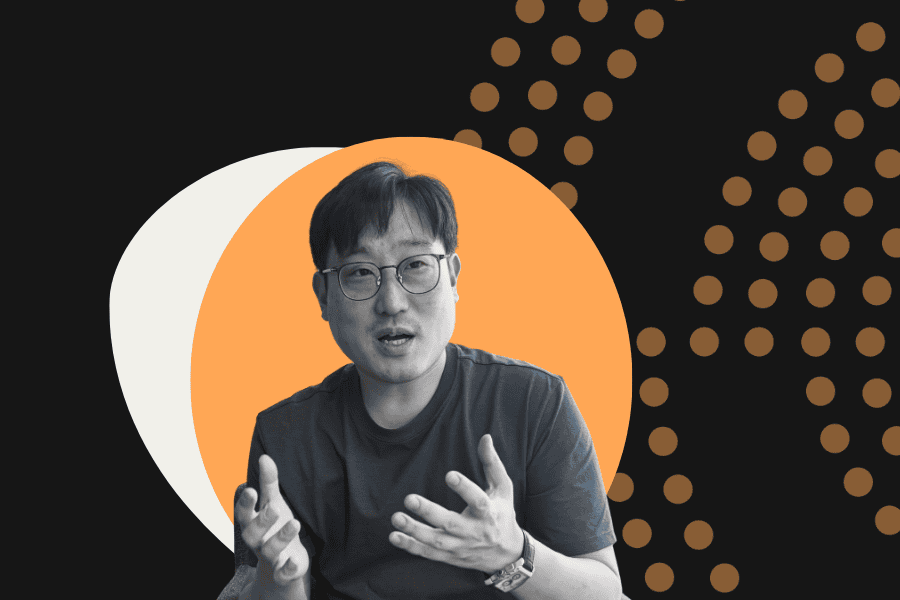
Dong Jin Kim is Kim Dae Jung Chair Professor of Peace Studies at Hanshin University, and ISE Adjunct Professor in Peace and Reconciliation at the School of Religion, Theology, and Peace Studies, Trinity College Dublin. He conducts engaged research, collaborating with various humanitarian and peace organisations, including OKCK, KSM, PSPD, and Corrymeela. He is the author of The Korean Peace Process and Civil Society (2019), co-author of Peace and Conflict in a Changing World: Key Issues in Peace Studies (2024), Nurturing Hope (2022), and co-editor of Reconciling Divided States: Peace Processes in Ireland and Korea (2022). He has published numerous research articles in leading international journals, including International Affairs, International Peacekeeping, Journal of Intervention and Statebuilding, Globalizations, Peacebuilding, Alternatives, the Pacific Review, Asia Europe Journal, Asian Perspective, as well as several Korean journals.
The transcript was originally generated using Zoom transcription software and has been edited for accuracy and readability. I have added hyperlinks.
Michelle Anderson: Jin, thank you for taking the time to speak with me. I’m delighted to include your perspective in this series, particularly because of your work on translocal peacebuilding and your experience working across contexts including the Korean Peninsula, Cyprus, and Ireland/Northern Ireland and many others, as well as your recent book with David Mitchell and Gillian Wylie, Peace and Conflict in a Changing World.
I have recently been grappling with how to learn across contexts without losing sight of their differences, and how local experiences connect to much larger regional and global challenges and transformations. I feel like those questions run through much of your work. Could you tell us a bit about your own background and how you came to the questions that have shaped your work? In particular, how did you come to develop the idea of translocal peacebuilding, and where has that led you more recently?
Dong Jin Kim: Thank you for your question. I am originally from South Korea, but my grandparents are from North Korea, so I was born into an IDP family. They were internally displaced during the active period of the Korean War. The Korean conflict is still ongoing. Although some people describe it as a dormant conflict, it remains an armistice rather than a peace situation. It’s a bit tricky to call it a post-conflict situation when there is, in many ways, still an ongoing war. Even the so-called Demilitarized Zone, or DMZ, is an oxymoron because it is one of the most heavily militarized borders in the world. It prevents us from interacting with those in the North.
My grandparents were stranded in the South and never set foot in their hometown again because of the armistice and the military demarcation line preventing people from crossing.
For many Koreans, particularly South Koreans, the division of the Korean Peninsula and the legacy of the Korean War are simply always there. They are connected to everything you see in Korea. At the same time, we also live in a kind of bubble because this reality becomes normalized. The conflict is always present, but most of the time you simply live your daily life without actively engaging with it.
You hear about nuclear weapons and missile development in the North, but life continues. Then, at some point, you join the military– as I did, because military service is compulsory– and suddenly you’re exposed to an almost alternate reality. In the military, you are taught that your enemies are just across that border. You don’t necessarily think about it in everyday life, but once you’re in the military, it becomes central to your life.
It’s almost a kind of cognitive dissonance for many people growing up in South Korea, particularly for the half of the population who undergo military service and are trained as potential killing machines against those on the other side. In my case, those “others” are also my relatives. They are my grandparents’ family and the people from their hometown. Growing up in this situation, there was another dimension as well. I grew up under South Korea’s military dictatorship, which justified its authoritarian rule by invoking the Korean conflict. For me, that government simply felt normal because it was the reality I was born into. For example, when I was growing up there were art competitions for primary school children in which they were encouraged to draw North Koreans as red devils with horns. Children competed to produce the most vivid or convincing depiction of North Koreans as monsters. That was part of the indoctrination. But fortunately, at the end of the Cold War, Korea entered a new era. North and South Korea agreed to begin a peace process, and, in the meantime, South Korea became democratized.
Then I was fortunate enough to travel across the border between North and South Korea on a humanitarian mission. I worked with several NGOs, including Okedongmu Children in Korea (OKCK), which supported hospitals and nutrition initiatives. These were remarkable achievements in fostering interaction between people who were considered enemies, but were in reality, members of the same family. It’s a very strange situation because the division was, in many ways, artificial. Two Korean states were created on a peninsula divided by the superpowers, the United States and the Soviet Union. Then came the war, and these newly established states, together with the wider geopolitical context, effectively asked people who had once lived as one family to hate one another and see each other as mortal enemies. That extended even to educational practices that encouraged children to draw the people on the other side as devils.
For those of us involved in humanitarian work during the famine in North Korea, it was never just about delivering humanitarian aid. It was also about rediscovering the common humanity between so-called enemies and remembering that we had once lived together as one family. It wasn’t simply about political unification– that belongs at the political level. It was about how we could reestablish relationships at the human level.
The problem was that our peace process eventually broke down, in 2010, and that was devastating. No one expected it. We had experienced roughly 10 to 15 years of peacebuilding and engagement, and we believed we were moving in a different direction.
My last visit to Pyongyang was in 2008 for the opening of a children’s ward at Pyongyang Medical School Hospital. It was the first dedicated children’s hospital within the medical school.
At the time, people never imagined that, after all of that interaction and the rediscovery of one another’s humanity, we could go back to where we had been. But the breakdown of the political peace process made exactly that happen.
There were many reasons why the peace process broke down. There were broader geopolitical changes following the Iraq War. The Bush administration placed the DPRK on the “Axis of Evil” list, which understandably angered North Korea. Although negotiations continued through the Six-Party Talks, and a number of political agreements were reached, the peace process ultimately collapsed in 2010 when the South Korean government introduced the May 24 Measures, which restricted engagement with North Korea to purely humanitarian relief. We could no longer visit or monitor humanitarian and development projects in the country. After that, additional UN sanctions were imposed in response to North Korea’s nuclear and missile programs, making engagement even more difficult. Together with South Korea’s National Security Law, opportunities for humanitarian and peacebuilding cooperation became increasingly restricted. At the same time, North Korea became increasingly closed following the collapse of negotiations with the United States, making sustained interaction across the border even more difficult.
This is relevant to how I came to develop, or perhaps observe, the translocal turn in peacebuilding.
During this period, while trying to restart humanitarian work and peace and reconciliation efforts between North and South Korea, I had the opportunity to spend a sabbatical in Ireland because I was very curious about other divided societies. That sabbatical ended up becoming 12 years! Now, I’m not comparing Northern Ireland with North Korea– that would upset people terribly. But my first trip from Dublin to Belfast, hosted by David Mitchell, was quite remarkable for me.
The first thing that struck me was taking the train across the border. There was no visible dividing line, with only small differences like the road signs changed from kilometres to miles, and your mobile phone switched to roaming. In the Republic you see Irish alongside English, whereas in the North you generally do not. Other than that, you could almost miss the fact that you had crossed a border. Experiencing that journey for myself was so different than simply reading about it. It raised a number of questions for me about how this had become possible on the island of Ireland, and then I understood that the Irish and Korean situations are vastly different, even though Koreans were once referred to as the “East Irish!”
The concept of parity of esteem was really something to me. How can people remain who they are despite their differences?
For many years, Koreans looked primarily to Germany as the model for reunification, but I think Ireland presents something else to consider. There has not been unification on the island, yet people maintain different understandings of statehood and national identity while living with an open border. The concept of parity of esteem was really something to me. How can people remain who they are despite their differences? What amazed me was that if you are Irish in Northern Ireland, you can still feel fully Irish. You’re not simply an Irish person living in a foreign country. You can still experience it as your home, even though that territory is constitutionally part of the United Kingdom. How people came to agree to that arrangement was fascinating to me.
I then began learning more about John Hume’s idea that Irish unity isn’t really about territory; it’s about people. Although he was speaking in the Irish context, that resonated deeply with me in the Korean context. There were family reunion programmes during the peace process, but the process was essentially a lottery, and my grandparents never had the opportunity to visit their hometowns. I was able to visit North Korea because I received special permission, but they never had that opportunity. For me, that reinforced that this is fundamentally about people, but Koreans remain deeply attached to questions of territory because we were arbitrarily divided during the process of nation-state building after the colonial period.
Another thing I realized came from attending the 30th anniversary conference of the Truth and Reconciliation Commission in Cape Town. Listening to people from across Africa and Latin America who had experienced truth and reconciliation processes, I was struck by the fact that, for many of them, these processes formed part of the painful journey of building nation-states after colonialism, and much of that process was arbitrary, just as it was in Korea. The histories, the forms of violence, and the methods of reconciliation varied considerably, but there was also a commonality. Following colonialism and the First and Second World Wars, many societies entered periods of independence, self-determination, and nation-state building, all in the name of peace, but this so-called dream of nation-states created new conflicts for many people.
In peace studies, we often describe conflict in terms of incompatible goals that create conflict parties, which reinforces the perception that local people are stuck in conflict because of these incompatibilities. But many of these incompatibilities are arbitrary. Like in Korea, you have this line. Who drew the line in the first place? It was two U.S. army officers who decided that the 38th parallel would become the dividing line, telling the Soviet Union to stop there while the United States advanced from the south. Of course, during the Korean War the front line shifted, but today’s border still largely follows that original division. If you look at parts of Africa or the Middle East, you see similarly arbitrary borders, yet people come to experience them as absolute reality. We treat these lines as though they are natural and unquestionable, when in fact they were historically constructed.
It reminds me of The Emperor’s New Clothes. Everyone insists that the emperor is wearing magnificent clothes, even though he is actually naked. Only a child asks the obvious question. In much the same way, these incompatibilities come to be treated as so real and sacred that people no longer question them. International actors then arrive and say, “We know how to resolve these incompatibilities in very civilized and Western ways. What you’re dealing with is the fragility of the state, so you should build a strong state institution.” The prescription usually includes democracy, human rights, and a market economy, on the assumption that a strong and fair state will protect people’s rights. This way of thinking is often described as liberal peacebuilding, although it is also referred to as liberal peace or liberal development.
I don’t disagree with these prescriptions. I want democracy. I want human rights. I’m less certain about the market economy, but I understand why these things are important. However, the core problem the local people are dealing with is not that they are inherently conflict-prone because of incompatibility– those are artificially imposed. The issue is international peacebuilders, particularly those coming from the Western world, arrive in societies experiencing protracted conflict and saying, “If you build a strong liberal state, you should be fine.” That is inherently contradictory, because they were the one who created these incompatibilities in the first place by drawing the lines arbitrarily, tearing people apart from one another.
What I realized through traveling across conflict-affected societies around the world is that our histories, cultures, and contexts are very different, but our commonality is that we can all rediscover our humanity amongst one another. It’s not because we are inherently conflict-prone or violent, but we’ve learned to believe that the naked emperor is wearing beautiful clothes. We need to be able to ask why the emperor is naked and to describe honestly what we can actually see, free from these imposed understandings. For me, translocal learning is not just about learning; it’s also about unlearning. It’s about rediscovering things that are already natural to us. Even without laws, I don’t think people naturally go around punching each other in the face all the time. People are generally kind to one another, and I don’t think we need to be taught that.
I also came to realize that translocal learning isn’t necessarily about learning from other people who are in similar situations. At first, I was thinking in terms of comparison. My work with David Mitchell comparing Ireland and Korea was really about how I could draw lessons from Ireland. But as time went by, and I worked with people in Ireland/Northern Ireland in the civil society sector who were dealing with all these impasses and stumbling blocks, I realized that none of them felt entirely happy about the peace process, and they had their own issues. Through that, what I realized was that we are engaged in a similar struggle: how we can go back to living as human beings in a more natural way of being together, despite all these artificial realities imposed upon us, whether we call them the state, culture, or something else. Now, I’m not an anarchist. I recognize the value of state institutions and many of the things that liberal peacebuilding advocates. But what I’m trying to say is that these things should serve people, not the other way around. When you’re deeply embedded in your own local context, it’s really difficult to realize this.
I think this is what John Paul Lederach talks about in terms of imagination– the power of imagination. He draws on the idea of the sociological imagination and reinterprets it as the moral imagination. But for me, it’s not just about imagining something that does not yet exist. It’s also about seeing what is already there– almost like a child saying, “But he’s naked.” How do we actually see that? How do we develop the sociological imagination to look at what is presented to us as reality– for example, as a Korean looking at a militarized border?
I’ll start with two anecdotes. I am part of a network called Drawing Hope. It’s about both drawing and drawing hope at the same time. The project is about how we can counter that artificial indoctrination of identifying one another as enemies, like we went through in Korea, where children were encouraged to draw the other side as devils. Instead of drawing the other side as devils, we asked young people to draw themselves as human beings. We exchanged those drawings with children in North Korea, and eventually young people were able to meet one another.
When we were no longer allowed to do that, I organized an exhibition of children’s drawings from North and South Korea with Ulster University and the W5 Museum. It created a platform for children from across Belfast, from different communities and identities, to come together and view the exhibition. What really struck them were the messages in the drawings. They said things like, “I want to dance with you one day,” “I want to play with you one day,” “I want to play football with you one day,” “I want to be a scientist,” and “This is my school.” The children in Belfast would ask, “But why are these children separated?” The teachers were amazed because these children themselves were growing up in a segregated education system and had never really questioned that separation or thought it was unnatural, but looking at the drawings by Korean children prompted them to ask those questions. The project continued to grow, and today it involves young people from 16 countries. Last year, we exhibited drawings from North and South Korea, South Africa, Colombia, Ireland/Northern Ireland, Cambodia, and many other conflict-affected places at the United Nations Headquarters in New York, bringing together youth organizations from across these different contexts.
The most recent exhibition took place at the border between North and South Korea and included drawings from Palestine, one of the newest additions to the project. The organization Seeds for Development and Culture participated, and one of its board members, Tasame Ramadan, came to Korea for the opening of the exhibition. What she said was striking. She explained that she was 16 years old the first time she was able to leave the West Bank. When she visited a European city, she realized for the first time that there are people who live without checkpoints. Going through checkpoints every day had been such a normal part of her life that she had never questioned it. She often wondered whether people demonstrating in support of Palestine could really understand what everyday life in Palestine was like. When she came to Korea, she said she didn’t feel it so much in Seoul; it was only when she visited the DMZ that she thought, “The Koreans get it.”
I learned more about Korea when I was in Ireland than I did when I was in Korea, because I could really see myself in another context, just as Tasame from Palestine did in Korea.
Through the Drawing Hope project she met young people from Ukraine, Armenia, Cambodia, Sri Lanka, and many other conflict-affected societies. Although their situations were different, she felt they were all engaged in a common struggle confronting arbitrary walls created by larger systems of war. That’s why I think local initiatives are essential, to help develop that broader imagination. International actors are important, but sometimes what helps most is connecting with other local communities facing similar situations. Through that solidarity, we are sometimes able to see ourselves more clearly.
I learned more about Korea when I was in Ireland than I did when I was in Korea, because I could really see myself in another context, just as Tasame from Palestine did in Korea.
MA: Thank you for sharing all of that. You touched on many of the things that I wanted to ask you about! One idea that really stood out was your emphasis on imagination and our capacity to see beyond the realities we’ve come to accept. What do you think helps people cultivate that kind of imagination? What roles do individuals, communities, and institutions play in creating the conditions for it?
DJK: Thank you so much, Michelle. I briefly mentioned how we need to unlearn some of the things we have learned through the education system. Of course, education is important, and we need to learn about ourselves, our society, our cultures, and everything else. I’m not trying to negate any of that.
I’m not idolising children, they can be annoying and ask silly questions. They’re curious and unruly. When I returned to Korea from Ireland, I saw a sign on the train that said, “Be quiet in the train car. Control your children.” It struck me that children– and childishness itself– are often treated as something that needs to be controlled. Yet when I think about how we create space for peace, I think it’s about recovering the child within ourselves.
Children are not our future; they are our present. Children don’t need language to communicate with one another, they can simply play together. They can be greedy or selfish– that’s also part of human nature– but they don’t naturally kill one another or create weapons. Those things are learned. That’s why I don’t think peace education is about teaching people to become more peaceful, in the same way that peacebuilding isn’t about internationals coming to teach local populations how to be more peaceful. It’s about creating space where our relationships and our societies can become a little more childlike. For that, we need help from young people. That’s why, for me, it’s not only about translocal learning, but also transgenerational learning and unlearning.
It also shouldn’t only be about educating young people. In Ireland/Northern Ireland, for example, one of the dangers– and I think this is true in many parts of the world– is that adults know the Troubles were terrible. They don’t want to repeat it. Yet they still tell young people that certain people are the enemy, and those narratives remain. The younger generation never experienced the war themselves, yet they are the ones who may end up entering into conflict again because of the narratives passed on by the current generation.
So how do we cultivate that imagination– the ability to see the world the way children do, with a certain transparency? It’s not about escaping into a fictional world. It’s about recognizing the world as it actually is. Most people are not punching one another in the face all the time; we are generally kind to one another. We just need to remember that this, too, is part of reality, despite impositions like the nation-state, culture, and what Johan Galtung would call structural or cultural violence. Even if someone is considered your enemy, can you still relate to them as another human being?
I don’t think people like Desmond Tutu or other Nobel Peace Prize laureates are anomalies or heroes in isolation. I’m sure they were surrounded by relationships that helped them remain human. The key is how we create those kinds of support systems. Maybe it’s a bit like Alcoholics Anonymous; these artificial realities are addictive. The question is: how do we help one another return to a more natural way of being together? That’s what we should aspire to. That’s when you feel you can finally breathe. For example, in Northern Ireland, I am a member of Corrymeela. It’s a dispersed community, and we’re trying to create that kind of space. People from around the world visit Corrymeela to breathe and feel that it’s okay to be human beings. I think we need more spaces like this.
A few years ago, I had a conversation with John Paul Lederach about translocality. I was pitching this idea that places like Corrymeela and other organizations create relationships that transcend restrictions, ideologies, and divisions, and that these spaces can be generously shared with people from other local contexts. John Paul suggested thinking of them as acupuncture points. For example, you have the Corrymeela Community, the Okedongmu Children in Korea, and the Desmond & Leah Tutu Legacy Foundation in South Africa. That led us to create a project called Nurturing Hope around this idea. These are places where you can breathe. You realize you’re not alone in trying to remain human in a dehumanizing world divided by class, identity, religion, ideology, or something else. They create opportunities to relate to one another naturally and with empathy, rather than through fear or criminalization. In Korea, for example, under the National Security Law, dreaming of playing football with children from North Korea could be considered a violation of the law. When you put it like that, it sounds absurd, yet similar dynamics exist in different ways around the world. The question is how we expose that absurdity, and I think we do that by building solidarity with one another.
The idea behind translocal peacebuilding research is to understand how people work to remain human in different contexts, and how those experiences themselves can become part of our knowledge production.
I think the same is true in academia. We’re so accustomed to systems of knowledge production that have largely developed in the West. I’m not vilifying the Western world, but the problem is they have this desire to make things universal, and I don’t think it works that way. The idea behind translocal peacebuilding research is to understand how people work to remain human in different contexts, and how those experiences themselves can become part of our knowledge production. Through different case studies and different conceptualizations of peace, we can develop a fuller understanding.
I think academia and universities can become these acupuncture points too, because they’re places where people can breathe. We don’t have to remain trapped within theories of realism or liberalism. We can develop a more open understanding together.
MA: I like the term acupuncture points and the idea of universities potentially being places like that. That’s certainly what we’re hoping to explore through this program. There’s a lot of food for thought there.
As a way of wrapping up, given your experiences and expertise, what do you think is important for people thinking about peace in the long term to keep in mind, especially given the changing conditions and challenges shaping the world today?
DJK: I mentioned Tasame’s story earlier. She saw these struggles as a common struggle against the system, and I agree with her. But she didn’t mean that we are here to dismantle the system or compete against it. She was simply happy to be with people who are on the same journey, navigating these systems together and asking how, despite all of this, we can remain human. That’s not really a goal, because we are already human beings. The question is how we remain who we are.
I also mentioned this desire to create universal knowledge and universal solutions. Sometimes we become so focused on fixing systems and structures that we begin to think we simply need to replace one system with another, and I don’t think that’s the answer. Any system or institution– whether it’s the market economy, democracy, or anything else– can never be perfect because these are institutions created by human beings to meet particular needs at particular moments in time.
What doesn’t change is that we are born as human beings, and the next generation will also be born as human beings, equipped with empathy. What we need is to trust in our humanity. I’m not putting human beings on a pedestal, we’ve done terrible things. I’m not advocating for individualism either, but the things done in the name of states or national interests represent the interests of things that are non-human. States are not human. Systems are not human. Industry is not human. The economy is not human. At all. That’s why I think our real hope for peace lies not in building better institutions, but in looking within ourselves and asking how we relate to one another.
That’s the only thing I know that keeps us going. What I love about peace studies and peacebuilding institutions is that they bring together people from all around the world. It’s already translocal. That’s why I say your institution is an acupuncture point. It’s not about institutionalizing something. It’s about creating a platform, as John Paul Lederach says, where people can come together and experience it. They can realize, “It’s still okay.”
Then, with those relationships built among the cohort, people can return to where they came from knowing they’re not alone. I’m here in Korea, but I’m not alone because I have all these friends from other local contexts. I’ve lost friends along the way, but they’re still with me because they’ve made me who I am. What I’ve been saying to you today isn’t coming just from Dong Jin Kim. I’m speaking from what I’ve experienced with people from Ireland/Northern Ireland, South Africa, Palestine, the United States, Colombia, Cambodia, Sri Lanka, and other conflict-affected places. Those relationships I’ve built with people who share this way of thinking are the reason I still feel we have hope.
I also hope that this is not an exclusive sort of knowledge or a kind of relationship that’s only possible because I have the opportunity to travel. The quest for us is how we could create this local-to-local platform on this broader scale, and that’s why I think the work of yours, Michelle, is very important because you are one of those platforms.
MA: Thank you Jin, I appreciate that. That’s a beautiful reflection and a great way to wrap up. [cat pops into frame] Betty thanks you too.
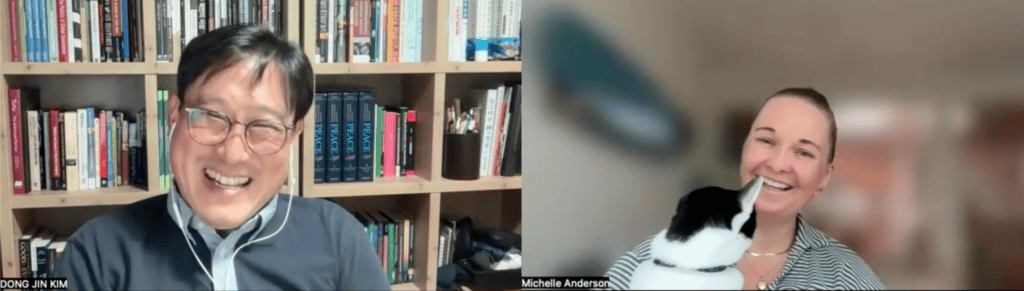
DJK: Thank you, Michelle, and thank you, Betty.