This blog is part of our “Famine Voices” project, that intends to bring diverse perspectives on famine, with a particular emphasis on the voices of victims, survivors and those who are closest to them, to wider debates on the understanding of famine, including measurement, policy, theory and accountability.
The UN-backed Integrated Phase Classification began its work 21 years ago, during a famine in Somalia. It classifies phases of food insecurity: famine is the worst phase. For the IPC, famine happens in a specific time and place – it could be a county, or an entire country, it could last for weeks or years. It’s marked by extreme food insecurity affecting one in five households; acute malnutrition, affecting a third of children, and two hunger-related deaths per 10,000 people per day.
This definition is technical, and it gives policy makers the feeling that famine has an off-switch. Reduce mortality rates, or malnutrition rates, or household hunger, and famine ends. The technical definition is somehow at odds with the experiences of people living in famine-affected societies. In South Sudan, people enduring extreme food insecurity link their experience to different drivers, which cannot be easily switched off: floods, climate catastrophe, war, inter-communal violence, displacement and agrarian change. For South Sudanese people, these processes stretch out over years or decades, and people consistently have to improvise responses to them.
I’d like to explain about some of these processes, and the way that people responded to them: floods, wars, displacements, and deep changes to agrarian and pastoralist livelihoods. I am speaking from the perspective of Dinka communities.
Floods
Between 1961 and 1964, major floods upended the lives of agro-pastoralist communities across South Sudan’s flood plains. Cattle-keeping communities of the eastern flood plains – such as Dinka, Murle, Nuer, and Shilluk – were the most affected. Many were displaced to unfamiliar environments in Bahr al-Ghazal, Equatoria, or the cities of northern Sudan. Their cattle were wiped out and their livelihoods were traumatized to the core. Women, children and elderly people died from disease and malnutrition.
A few years before the floods began, the first nutritional survey of the flood region found that average calorific intake varied between 2000 and 3000 calories per day. During the dry season, calories were lower and milk was a more important food source. After the harvest, sorghum was more important. The floods and displacement sent many people off on long hungry journeys (Jonglei Investigation Team 1955, Ogilvy 1981).
These flood journeys led to mental trauma. They separated families and relatives and weakened family, clan, sectional and communal networks of survival. Families and relatives were separated and desocialized from each other for long time. Tens of thousands of relatives grew up without knowing each other, not reconnecting until the independence of South Sudan in 2011, a whole lifetime later.
Wars
Sudan’s second civil war (1983-2005) was one of Africa’s longest and most devastating conflicts (Deng 1995, Johnson 2003). Deaths in the Bahr al-Ghazal famine of 1998 reached 800,000 people, comparable with the Rwandan genocide. People were displaced across the African continent. Deaths from starvation and suicide traumatized families.
The second civil war led to the spread of small arms into the hands of civilian population. Few civilians disarmed after the second war concluded in 2005. These firearms have led to the increase of local cattle raiding, land grabbing and revenge killings within and between communities. South Sudan’s first civil war, which began in 2013, has greatly aggravated these local conflicts, leading to breakdown of social systems and networks among clans, sections and communities.
Famine voices
Starvation can destroy social networks. In Dinka culture, the death of a relative from starvation is seen as a negligence from immediate family members and other close relatives. Living relatives of the deceased persons who have died from starvation often live with an everlasting shame and stigma. Negative songs are composed and sung against the families, clans and sections whose loved ones have perished from starvation.
But people use social networks to defend against famine. In normal times, Dinka chiefs monitor hunger in their communities. When they find starving people, they mobilize resources from their immediate relatives. Relatives donate lactating heifers to starving families. After the starvation period ends, heifers are returned to their rightful owners. Families make up losses by having more children.
When I was growing up in the rural South Sudan throughout the 1990s, 2000s and mid-2010s, rainfall used to start in March. But since 2013, rainfalls have become unreliable. Farmers wait longer before starting cultivation, and they sometimes give up on long-maturing indigenous sesames, millets and sorghums, which need long rains. Instead, they adapt short-term maturing and bouncing back crops. Some of these crops are not indigenous ones. This means that the communities have lost their dietary and cultured tastes of their stable food products.
Let me conclude by telling the story of my aunt, Mary Ajok Wetkwout Malual who fled to the cities of northern Sudan in the early 1980s, when war came to Rumbek. I first met her when she returned to Rumbek in 2010. Like me, Mary was from an all-woman household, and she was renowned as an exceptional farmer, a woman who organized her family’s food, a custodian of seed knowledge.
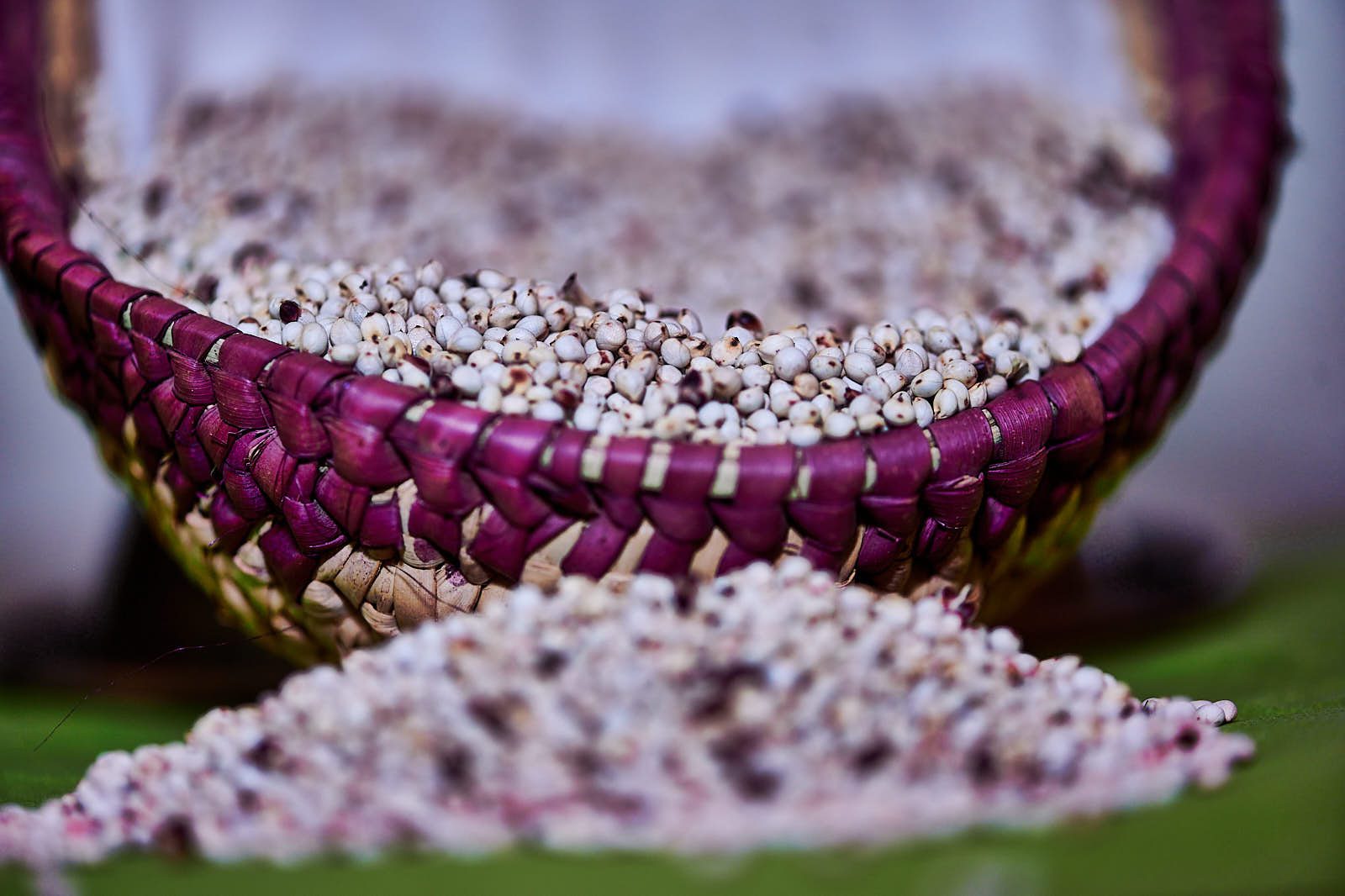
She kept her seeds in little black drawstring bags – bags that could be grabbed if she had to flee in a crisis. She had short-maturing sorghums that allowed her to recover production after displacement, and long-maturing sorghums. Kech is a long-maturing sorghum. It tastes better than short-sorghum, and it’s used in rituals such as child naming and other birth rituals. When Mary fled, she took kech with her to Kassala, a town in the north of Sudan. She worked as a cook, and she managed to get a small plot where she grew kech, and shared it during rituals. Many Dinka people in Kassala used her grains. When she came back to South Sudan, she still cultivated kech in a little plot in the capital Juba.
People use food to maintain social networks. When Mary was young, food production was organized socially, within the family, rather than through markets in labour, land or food. In her own lifetime, she became a waged worker. And across South Sudan, people are changing the way they produce and obtain food. Gun culture has transformed cattle systems, and changing rainfall and displacement have transformed farming. But people like my aunt still use food production as a way of keeping people together, a way of investing in social networks that keep people alive.
This article was made possible in part by a grant from Carnegie Corporation of New York. The statements made and views expressed are solely the responsibility of the author.