“…most things in the future will not depend purely on an acceptance of data and scientific discoveries, but on our own capability to interpret and manage their effects, looking to understand what is really at stake.” – Slavoj Žižek, in The Year of Dreaming Dangerously
Many of the transformations most likely to shape the coming decades are already underway. They are neither distant possibilities nor predetermined futures, but consequential developments whose effects will continue to unfold over timescales that– no matter what policymakers promise, prioritize, or deny– exceed election cycles and leadership transitions. Yet the significance of such changes lies not simply in the fact that they are occurring, but in what they may mean for the worlds to come. Looking further ahead therefore requires more than just anticipating major global changes; it requires grappling with their implications, understanding what is at stake, and considering how future possibilities may be shaped by choices made in the present.
This essay explores several projected transformations likely to shape the world through the middle of the century and considers what they might mean for peace.
This approach takes projections and forecasts not as definitive predictions, but as starting points for thinking about the changing terrain within which peace will need to be imagined and pursued. Demographic change, urban growth, ecological pressures, technological infrastructures, and transformations in governance are not separate from questions of peace. They shape the material, political, social, and ecological conditions through which people live together, contest power, access resources, and navigate insecurity. While projections remain imperfect and contingent, engaging likely future transformations can still help identify emerging pressures, constraints, and areas of political and institutional tension. Crucially, these anticipated transformations will not produce singular or predetermined outcomes; similar projections have historically generated both catastrophic and utopian predictions for their implications, many of which proved overstated or incorrect. How such changes are governed, contested, distributed, and responded to will matter enormously for how they are ultimately experienced. The point is not to rely on supposedly certain futures for moving the work of peace forward, but to consider how key large-scale transformations may shape the conditions under which future peace may unfold, offering just one starting point for thinking about the work to come.
The year 2050 is a timeframe widely used across climate modeling, urban planning, demographic forecasting, AI governance discussions, and international development agendas, making it a shared reference point across multiple domains shaping the future. Although many projection models also extend beyond this, the often-shared use of 2050 offers a useful first horizon for thinking about structural transformation: distant enough to foreground large-scale shifts already underway, but close enough to remain connected to today’s institutions, infrastructures, governance systems, and populations.
What follows highlights several projections for the world in 2050 that are likely to (re)shape the ways peace is pursued, experienced, and challenged, while raising broader questions about what kinds of political, institutional, and social arrangements may become necessary under rapidly changing conditions.
1. Demographic change
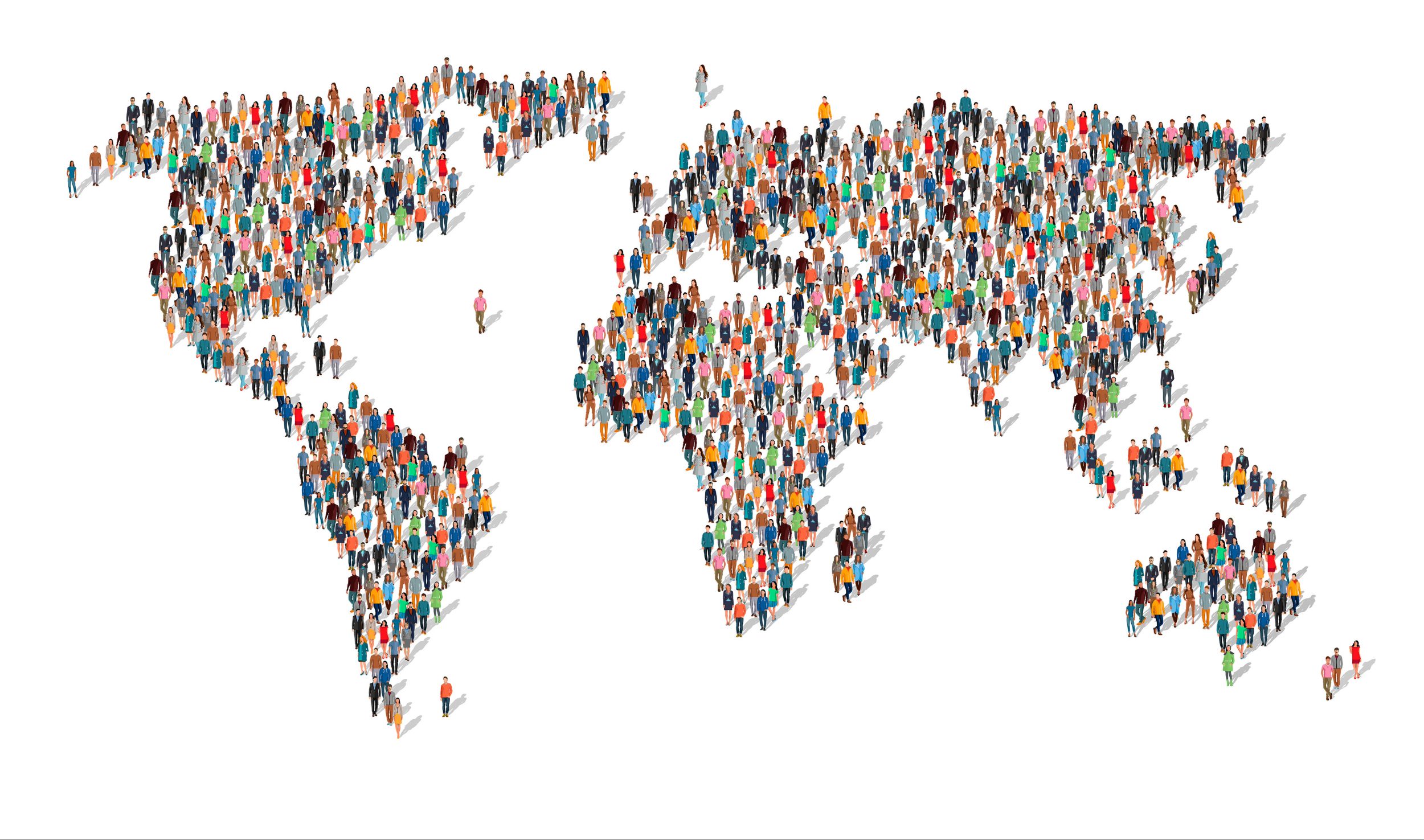
One of the clearest projected transformations shaping the coming decades is demographic change, not only in terms of global population growth, but also in how populations are distributed, aged, and organized across regions. The United Nations projects that the global population will increase from approximately 8.2 billion today to roughly 9.7-9.8 billion people by 2050, and is projected to peak at around 10.3 billion people in the mid-2080s. However, this growth will be highly uneven. More than half of projected population growth is in sub-Saharan Africa, while many countries in Europe and East Asia are projected to experience demographic aging, low fertility rates, and, in some cases, long-term population decline. Demographic change will also be shaped by migration, as climate pressures, conflict, economic inequality, and urbanization continue to shape broader patterns of human mobility and displacement.
Why this matters for peace: These demographic transformations raise questions about political representation, labor systems, migration governance, social cohesion, intergenerational inequality, and shifting social welfare needs. Existing international institutions and governance systems were largely built around earlier demographic realities, and tensions may increasingly emerge between existing political and institutional arrangements and rapidly shifting demographics. Migration is likely to remain structurally central to the global economy, particularly as aging societies confront growing pressures around workforce decline, care infrastructure, healthcare systems, and economic sustainability. At the same time, many states may face growing tensions between economic dependence on migrant labor and increasingly restrictive borders. Questions of migration and mobility– including who is able to move, under what conditions, and with what protections– are already and increasingly central to debates about borders, citizenship, belonging, labor, and national identity, impacting how stability and exclusion are organized globally. In contexts marked by high levels of unemployment, inequality, and political marginalization, expanding youth populations may also intensify existing social and political pressures, even as younger and faster-growing regions play an increasingly important role in shaping global political and economic life.
2. An urban world
By 2050, nearly 70% of the world’s population is projected to live in urban areas, with much of this growth concentrated in Africa and Asia. The number of people living in cities with populations exceeding one million residents is expected to continue rising significantly, while large metropolitan regions and peri-urban corridors expand rapidly. Further, the urban experience is likely to remain highly unequal. Hundreds of millions of people are projected to continue living in informal settlements or areas lacking adequate housing, sanitation, transportation, public space, and resilient infrastructure. Many estimates suggest that a substantial share of the urban infrastructure required for 2050 has not yet been built.
Why this matters for peace: Urbanization changes where and how peace is negotiated in everyday life. Questions of housing access, transportation, sanitation, electricity, environmental exposure, policing, and infrastructural inequality are not separate from peace and security; they shape experiences of safety, precarity, exclusion, and political belonging. The persistence of informal settlements and uneven urban development further raises questions about whose security is prioritized and whose precarity becomes normalized. Additionally, urbanization may reshape the organization and experience of violence and insecurity in ways that differ from rural insurgencies and conventional models of internal or international armed conflict. As populations concentrate in large urban regions, cities may become increasingly important governance actors in shaping responses to migration, climate adaptation, public health, and inequality, particularly where national political systems struggle to respond effectively.
3. Ecological and material pressures
By 2050, climate and resource pressures are expected to intensify substantially. Hundreds of millions of people are likely to face increasing exposure to extreme heat, flooding, drought, sea-level rise, and water stress, with risks becoming increasingly concentrated in urban areas, coastal regions, and places already experiencing high levels of inequality and infrastructural vulnerability. Simultaneously, global demand for energy, cooling, transportation, housing, and critical infrastructure is expected to continue rising alongside population growth and urbanization. Electricity demand is projected to increase significantly by mid-century, even as societies accelerate transitions toward renewable energy systems. Food systems are also expected to face growing strain from climate impacts, water scarcity, land degradation, and shifting weather patterns, while accelerating biodiversity loss and ecosystem disruption introduce further ecological uncertainties with long-term and potentially profound consequences.
Why this matters for peace: Climate and resource pressures increasingly shape the conditions under which people live, move, govern, and access resources. The future of peace is therefore closely tied to adaptation: the capacity and will of governments, institutions, and communities to respond to environmental stress, maintain infrastructure, manage displacement, and reduce unequal exposure to risk. These pressures are also likely to reshape geopolitical relationships and economic systems. Energy transitions, competition over critical resources, and uneven access to electricity, clean fuels, and resilient infrastructure may become increasingly important sites of both cooperation and political tension, particularly as the costs and benefits of adaptation and decarbonization are distributed unevenly across and within societies. These dynamics blur conventional distinctions between environmental policy, development policy, and security policy. Questions of climate adaptation, infrastructure resilience, and resource access are likely to become increasingly central to stability, inequality, and peace.
4. Digitally mediated futures
By 2050, a growing majority of the world’s population is expected to live within digitally connected systems shaped by widespread internet access, mobile technologies, artificial intelligence, platform economies, and data-driven infrastructures. Digital connectivity is projected to continue expanding across much of the world, while governments, corporations, and public institutions increasingly rely on digital systems to manage communication, finance, education, labor, mobility, and governance. Artificial intelligence and automated systems are also projected to play a growing role in economic production, information systems, security infrastructures, and decision-making processes. Emerging technologies including AI-enabled systems, autonomous weapons, drones, cyber capabilities, and increasingly accessible surveillance infrastructures may also reshape how coercive power and organized violence are exercised by both states and nonstate actors. However, these shifts are occurring unevenly, with significant disparities in access to digital infrastructure, technical capacity, and regulatory power across regions.
Why this matters for peace: Political mobilization, governance, surveillance, misinformation, and public debate and some forms of organized violence increasingly occur through digital systems. Questions of trust, legitimacy, information integrity, and technological governance may therefore become even more entwined with questions about social cohesion and political stability. Digital infrastructures also shape who has access to information, economic participation, mobility, and political visibility, while AI and automation will significantly disrupt and reshape many forms of work, including professional and white-collar employment. Uneven access to connectivity and technological capacity may deepen existing inequalities between and within societies, while increasingly centralized digital systems raise new questions about accountability, concentration of power, and democratic oversight. Institutions responsible for governing social and political life may also struggle to adapt to rapidly changing technological realities. The challenge for the future of peace may therefore involve not only responding to emerging technological risks, but rethinking governance and cooperation in societies where political, economic, and social life are increasingly mediated through digital systems whose design, ownership, and governance carry significant political and social consequences.
Implications for the Future of Peace
These projections, among many others not covered here, illustrate why the future of peace cannot be reduced solely to diplomacy, conflict prevention, or postwar reconstruction. Peace will increasingly be shaped through infrastructure systems, demographic transitions, climate adaptation, urban governance, technological regulation, and struggles over mobility, inequality, and belonging.
None of these projected global changes inherently produce a singular or inevitable future; population growth does not automatically produce instability, just as urbanization, climate pressures, or technological transformation do not inevitably lead to conflict. Rather, the political, institutional, and social responses to these transformations will matter enormously in shaping how they are experienced, and what they ultimately mean for peace.
This matters in part because many of the assumptions, institutions, and practices through which peace has traditionally been pursued emerged under very different demographic, ecological, technological, and geopolitical conditions. The future of peace will depend not only on the transformations that occur, but on how they are understood and acted upon. Thinking seriously about the future of peace therefore requires a more expansive consideration of the institutions, networks, forms of cooperation, and political imaginaries needed not only to navigate emerging conditions, but also to shape the futures they make possible.
Selected sources
Demographic change
- https://population.un.org/wpp/assets/Files/WPP2024_Summary-of-Results.pdf
- https://www.pewresearch.org/short-reads/2025/07/09/5-facts-about-how-the-worlds-population-is-expected-to-change-by-2100/
- https://www.pewresearch.org/short-reads/2025/08/15/5-facts-about-global-fertility-trends/
An urban world
- https://www.un.org/development/desa/pd/sites/www.un.org.development.desa.pd/files/undesa_pd_2025_wup2025_summary_of_results.pdf
- https://ourworldindata.org/urbanization
- https://digitallibrary.un.org/record/3984713?ln=en&v=pdf
Ecological and material pressures
- https://www.ipcc.ch/report/ar6/syr/
- https://documents1.worldbank.org/curated/en/837771631204427139/pdf/Groundswell-Part-II-Acting-on-Internal-Climate-Migration.pdf
- https://www.iea.org/reports/world-energy-outlook-2023
- https://ourworldindata.org/energy-access
Digitally mediated futures
- https://www.itu.int/itu-d/reports/statistics/facts-figures-2024/
- https://www.worldbank.org/ext/en/topic/digital-and-ai
- https://sdgs.un.org/gsdr/gsdr2023
- https://unidir.org/publication/the-weaponization-of-increasingly-autonomous-technologies-artificial-intelligence/
- https://www.sipri.org/research/armament-and-disarmament/emerging-military-and-security-technologies/artificial-intelligence