This blog is part of our “Famine Voices” project, that intends to bring diverse perspectives on famine, with a particular emphasis on the voices of victims, survivors and those who are closest to them, to wider debates on the understanding of famine, including measurement, policy, theory and accountability.
South Sudan’s Dinka language does not distinguish between ‘famine’ and ‘hunger’. Chok is the Dinka word which covers both. The Ngok Dinka people of Abyei recognize that chok is caused by a poor harvest due to drought, flooding, political instability or poor economic performance. But chok is a word which is deeply linked to shame.
It’s partly the shame of laziness. In the absence of war, drought or flooding, people think that chok is caused by laziness, and that people who refuse to cultivate are a disgrace to the community.
But chok is also linked to deeper kinds of shame. Famine survivors do not want to share their traumatic experiences. Many people have lost their loved ones through starvation, and they could not help them. Some people had a little food, but could not share it with dying relatives because they felt that the food was not enough. Others resorted to violence through raiding, in order to survive.
Famine is one of the most shameful things, and many affected people do not want to speak about it. This creates ethical dilemmas for researchers. Looking at historical experiences, and at family experiences, can help researchers manage the ethical challenges of famine studies. I’m going to focus here on Ngok Dinka experiences of famine during the wars of the 1980s and 1990s. The violence, dislocations and separations of those years still shape experiences of famine today.
My aunt remembers the 1988 famine. At the behest of the Khartoum government, militias from northern Sudan deployed scorched-earth tactics against Dinka populations of Bahr al-Ghazal, the north-western third of South Sudan (Keen 1994). My aunt said that some of her neighbours starved to death, under the watch of their closest relatives who had cows. She said when the famine was over, some of the neighbours and relatives who witnessed how their loved ones died on their watch could not bear the pain and the social shame. Some even left the area.
My late younger brother and I remember the 1998 famine. Kerubino Kuanyin, formerly a rebel commander, made an alliance with Khartoum government, which sent him to his home area near Wau, to mobilize a militia. At the time, Luka Biong Deng described the way that ‘insider’ militias are likely to devastate food systems and social structures more deeply than ‘outsider’ armies. Khartoum’s ‘insider’ militia tactics are widely replicated in South Sudan’s present-day wars.
My late brother and I fled to Maridi in Western Equatoria, and we met a boy survivor of the 1998 famine on the way. One day, the boy narrated how his parents both died of starvation, and he and his sister were left under the care of his uncle. His uncle refused to give him and his sister milk. We stopped him before completing his narration because the boy was crying bitterly. An elder travelling with us tried to comfort him, by saying:
“My little brother, stop crying. You are not the only one who experienced such bitterness. Hunger closed our door (means all people in the family starved to death). I lost my five siblings. I survived because we had to steal other people’s cows and slaughter them in order to eat.”
Famine often can’t speak. Some people refuse to speak because they don’t want to share their means of survival. When we heard the elder speak, we understood that people suffered in many ways and their bitter memories of famine silence them.
Sometimes, famine experiences are recorded in song. One man who lost his wife and children in 1988, to attacks by the army and the Arab militia known as murahaleen, sang this one:
We spared nothing during this hunger
Some of us stole other people’s cows
Many men left their wives and children and ran to Khartoum for survival
We ate wild fruits
We ate dried and old cows’ skins
We removed grains from insects’ hole
The reason was because murahaleen burn and destroyed our homes and raided our cows
I’d like to talk about some other famine voices next. Some people speak up about famine in order to strengthen others. My mother had one of these voices. She took care of us during the 1988 famine. Her famine memories are not just about bitterness.
First, famine is a story about guilt and shame, but it’s also a story of bravery, and a story of maternal agency. My mother started out by gathering wild food to feed us:
“In order for you to survive boy sons, I had to join a group of women who went to the forest to gather leaves and fruits. At first I found it hard to identify safe fruits and roots of some plants and I was worried that I might bring to you poisonous one. Thank God I was able to easily learn how to gather safe food.”
Second, famine is a story about flavors. People remember the grain that was given out by humanitarian agencies. They called it arec goon, which means ‘The vulture refuses it.’ Vultures sometimes feed human faeces, and people observed that vultures would not eat faeces from this grain.
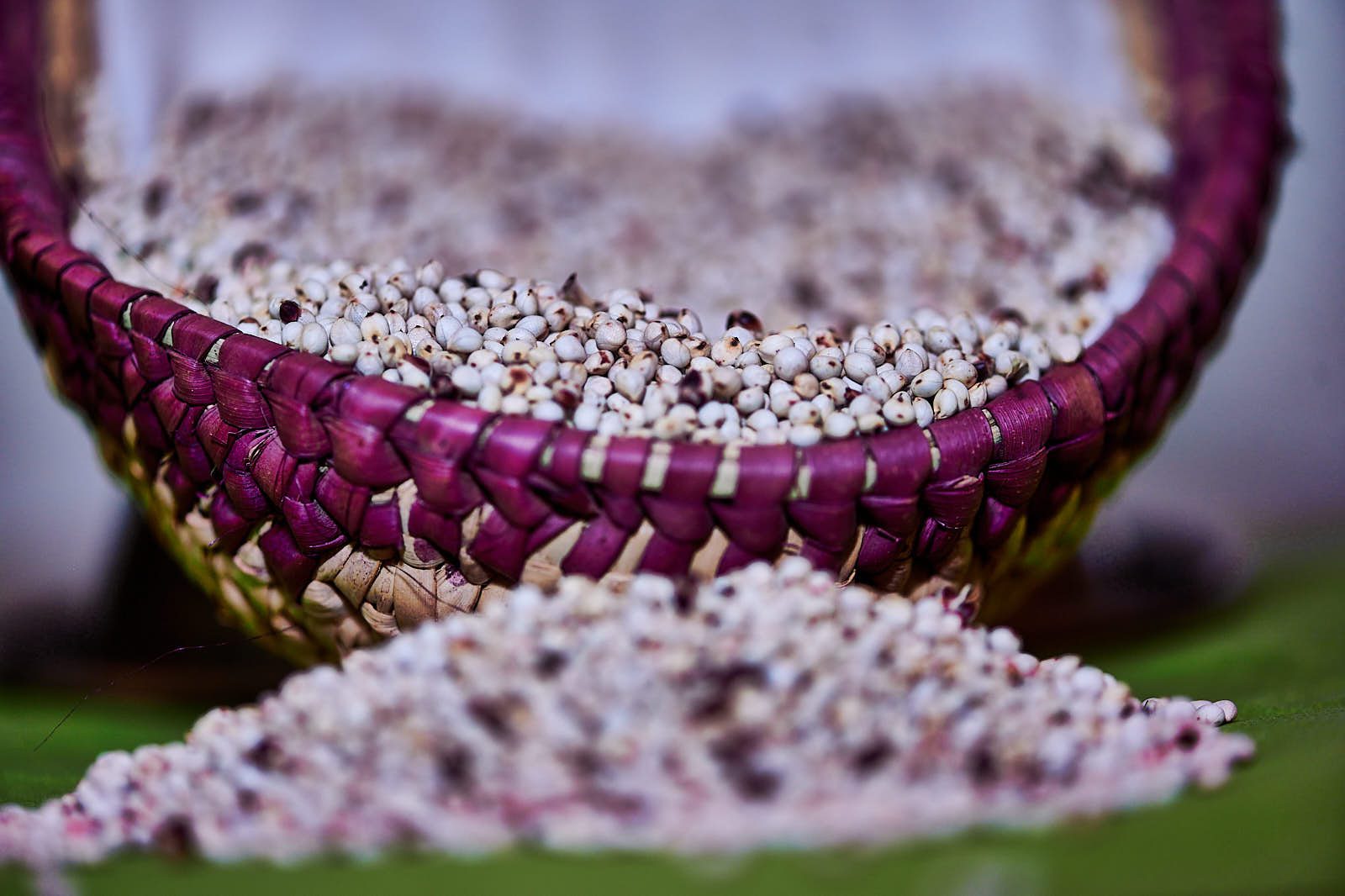
My mother risked her life to give us pre-famine flavors. Her favorite grain was a flavorful, slow-maturing sorghum called ruath. It’s used in Dinka rituals, and to make sorghum beers for special occasions. Her mother was a farmer and a seed expert in Abyei, but Abyei was under military occupation and my mother’s family couldn’t get to their lands. We were living in Twic, a county of Warrap state which neighbors Abyei. My mother stole into Abyei and smuggled out ruath seeds in a cloth, and sowed them in Twic. We were too small to help her. When we were all displaced again, my mother went to Khartoum and she stopped growing ruath. But when she got back to Abyei in 2005, she began raising ruath again.
There are famine stories about bravery and flavor. But there are also solidarity stories. Dinka culture, like many Sudanese cultures, stresses solidarity and sharing. During a famine, community leaders try to ensure that no-one dies a shameful hunger death. And everyone has a responsibility for sharing food. My mother’s uncle was a chief, and during the 1988 famine, he told his wives to give milk from his cows to anyone who asked. He told my mother to give two of her cows to a neighbor, with the promise that they would be returned when the famine ended. They were returned.
South Sudan’s solidarity systems are still vital to survival. They draw on systems of production and exchange which prioritize social solidarity. Famine voices still stress the importance of solidarity – even as it is eroded by climate change, floods, and the collapse of solidarity-based subsistence systems.
This article was made possible in part by a grant from Carnegie Corporation of New York. The statements made and views expressed are solely the responsibility of the author.