Power and money – that’s the ideology of geo-kleptocracy. Everything else follows from that. Some apex predatory political business moguls may be hard core racists or religious fundamentalists. But their shared core belief is that because they have lots of money and power, they have the right to rule the world.
But they’re vain as well as venal: they also need the public to believe in them.
The culture wars in America and Europe accompanied the end of the liberal peace and the global kleptocratic shift. Right-wing ideas didn’t cause that shift, but they justified it and shaped it.
In this blog post I will touch on three intersecting frontlines in the culture wars: Christian nationalism, sovereign individualism and neo-sovereigntism.
Different religious and cultural traditions have different theories of political power. Judaism has for millennia been distant from state power and divine authority lies in law rather than the figure of the ruler. This means Benjamin Netanyahu faces massive challenges in trying to legitimize his impunity. Islam has had charismatic rulers but God’s will and sovereignty reside in law and justice rather than any personification of the divine – which would in fact he a heresy. None of today’s Islamic states, namely Afghanistan, Iran and Saudi Arabia, have a ruler unconstrained by law – and the greatest vulnerability of the men in those governments is the charge of hypocrisy. The true despots in the Arab world have all been secularists. The Communist Party of China, notwithstanding its name and the ambition of its leader, is without ideology other than developmentalism – itself a protean managerial doctrine. China pursues this at unmatched scale. Hindu nationalism draws on modern refractions of ancient texts and doctrines – in that respect it resembles Christian nationalism, which is the driving force in World War X’s cultural warfront.
Christian nationalism is a creation of the era of modern European nationalism during the demoralization that followed World War I. The core element is that the identity, will and destiny of a people are manifest through a sovereign. Christianity is unique among world religions in that God becomes embodied in a human being, and the institution of a church represents that being. The person of the Pope was the embodiment of the divine and – in contrast to spiritual leaders in the other Abrahamic religions – is a lawmaker rather than an interpreter of law. This is the theological basis of sovereignty. In the modern era, it was codified by Carl Schmitt. Other hugely influential theorists include Leo Weiss and Eric Voegelin, for whom the Enlightenment had killed God and elevated rational man in His place. Liberalism, Voegelin argued, drained meaning and ethics from society, erasing traditional communities of purpose, and so opening the door to atheistic dictatorship. For many conservatives, liberalism was a fellow traveller with Bolshevism.
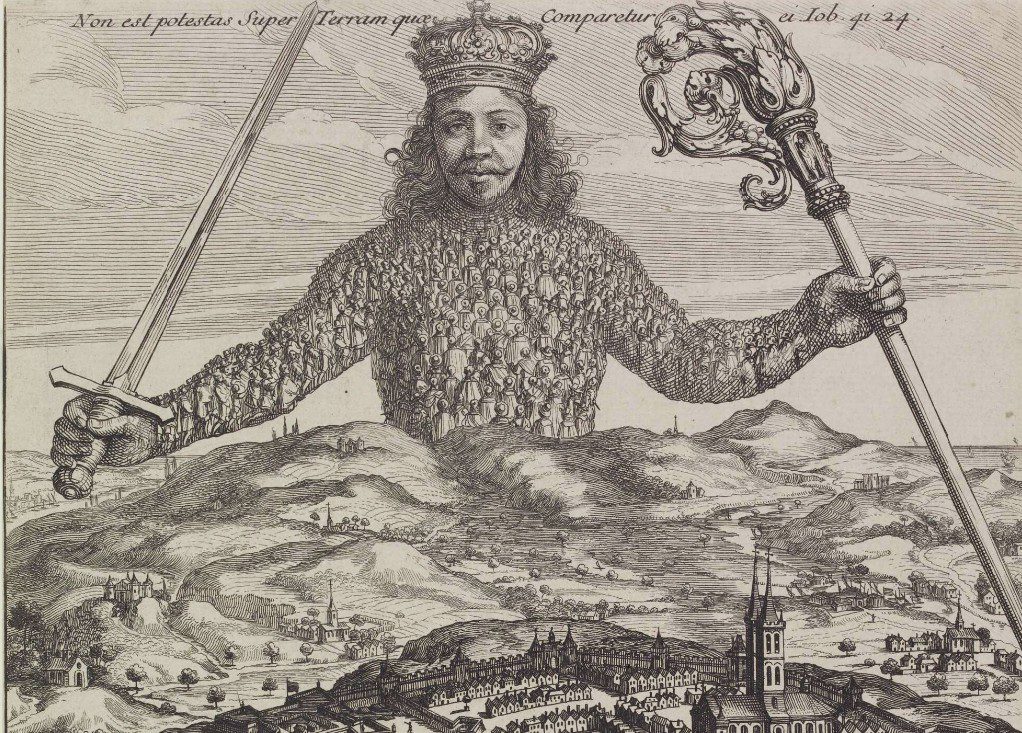
Their thinking chimes with Thomas Hobbes’ doctrine that the alternative to warre – or anarchy – is rule by a Leviathan. The frontispiece to Hobbes’ book of that name shows the autocrat made up of the bodies of his subjects – he is the people, his decision is their will.
This is the theory of democratic fascism – that liberal institutions of deliberation stand in the way of the sovereign who represents the true will of the people. In fact, political liberalism will direct the people on the path to hell. As with so much of the intellectual roadmap for 20th century politics, this was theorized in Vienna, where, in the words of the historian Janek Wasserman, Austro-fascists tried to tread ‘a fascist middle way between Nazism and democracy.’ A century on, Viktor Orbán in Hungary is reprising this, keeping elections, the judiciary and civic institutions, but as mere shells.
As we learned, it turned out that there was no such ‘fascist middle way’. Modernizing an ancient heroic ethos, Fascists extolled violence as virtue. In attacking liberalism, they also attacked the institutions of the liberal peace – the League of Nations and the Permanent Court of International Justice – seeing war as the right of the sovereign, that should never be subject to limitation.
This meant that the European reactionaries of the 1920s failed to police the boundary between conservatism and Nazism, and when they realized their naivete in mid-1930s, it was too late. Post-World War II Europe learned its lesson.
Today, many on the right have revived Oswald Spengler’s thesis about the ‘decline of the west’, seeing Nazism as a regrettable diversion from the White Race’s bigger historic challenge of protecting its homelands from peoples from elsewhere. Forgetful of, or uncaring about, the virulent strain of anti-Semitism in the nationalist right, the Israeli government wants its place inside that supposed civilizational fortress.
America’s 20th century experience wasn’t the same. Voegelin saw US democracy as fundamentally different, because the spirit of the frontier lived on. In his early writings he crystallized this in Josiah Warren’s concept of the ‘sovereignty of the individual’. Warren himself intended this to mean a rejection of any form of state control and a manifesto for freely-associating equal individuals running their affairs according to their own rules – an American frontier ethos. But in the hands of John Stuart Mill, Europe’s classic Enlightenment liberal, the sovereignty of the individual instead meant freedom of personal fulfilment – a version of aristocratic liberalism.
Financial capitalism and digital technology have transformed those ideas into something with real radical power. The Sovereign Individual, by James Dale Davidson and Lord William Rees-Mogg, first published in 1996 anticipates – and yearns for – a new era in which the ultra-wealthy achieve ‘escape velocity’ from the shackles of failing states and achieve total financial and personal autonomy. While conservative nationalism treasures tradition (pretending that tradition itself isn’t an invention of modernity) and preaches stability, Davidson and Rees-Mogg embrace disruption and disorder. Their ideas have been taken up by Peter Thiel (who wrote a curiously drab foreword to the second edition of The Sovereign Individual), Curtis Yarvin and Nick Land, among others. It adds up to a remix of 1920s reactionary thinking – now, as then, without guardrails against Nazism – supercharged by the ambitions of the mega-rich.
Like Austro-fascism, American national conservatism refuses to distinguish between liberalism, socialism and Marxism – a blanket, undifferentiated hostility that seems bizarre to those on the left, and one reason why the latter haven’t taken conservative thought seriously. Today’s American right also treats liberal multilateralism as worse than a hindrance, as an evil. In the same manner, Israel’s Likud puts Islamist radicals and liberals in the same camp, and invites neo-fascists to Jerusalem to commemorate the Holocaust.
Square-jawed, hard-muscled, using tough words, too many national conservatives are utterly soft headed and naïve about the perils of this path.
Fascism in its original European variant emerged from mass politics – plutocrats embraced it opportunistically for its corporatism and tolerance of monopoly. Today’s authoritarians emerge from the marketization of politics, so there’s a paradox that sovereignty is simultaneously eulogized and commodified. It’s exalted as the ultimate authority, a priceless inheritance from righteous ancestors, but is also treated as something to be traded in the market.
The term ‘neo-sovereigntism’ was coined by the Cameroonian political philosopher Achille Mbembe to describe the ethos of putschists in West Africa, where military men rallied popular support for overthrowing elected governments and repudiating all ties with the former colonial power. Coup leaders proclaim national sovereignty – but have very few of the standard requirements for sovereignty. They don’t control their territory, nor have monopoly on violence, and their influence over economic outcomes is marginal at best. They are merely switching from relying on French troops and United Nations peacekeepers to Russian mercenaries, a choice that they may already be regretting. The assertion of sovereignty is defiant rhetoric – and in practice it boils down to a demand for a better price in the international political marketplace.
Commodified sovereignty derives from a historical legacy of European empire in which sovereignty was purchased under duress by armed merchant companies operating under imperial charter, or simply stolen by them. In the colonized world, subaltern sovereignties could be sliced (divided up territorially with arbitrary boundaries), diced into segments (so that a local potentate kept some legal authority over his subjects, but surrendered control over foreign trade and security), ranked (by protocol and payment within the colonial hierarchy), and traded (with the imperial powers buying, selling and swapping territories). This pattern is returning. The geo-kleptocratic powers – Russia and other actors such as the United Arab Emirates, and Trump’s America – treat sovereignty this way. We see different variants in Russia’s approach to Ukraine, and the UAE in Yemen and the Horn of Africa, and the US in Venezuela and its claims on Greenland.
Today’s neo-Leviathans are a new breed – the CEO as emperor, the ruler as the financial godfather in the political bazaar. They’re at once ideological agnostics and skilled adopters of the enduring theology of sovereign absolutism – which means that the facts and values of today are whatever they say they are today, regardless of what they said yesterday and may say tomorrow.
As the political theorist Saul Newman writes: ‘political and economic theology is less about the modern power of religion – with which it nevertheless continues to be intertwined – and more about the modern religion of power.’