In the shadow of the widening US-Israeli war with Iran, the ruination of Lebanon, the latest and most devastating blow on an already fractured country.
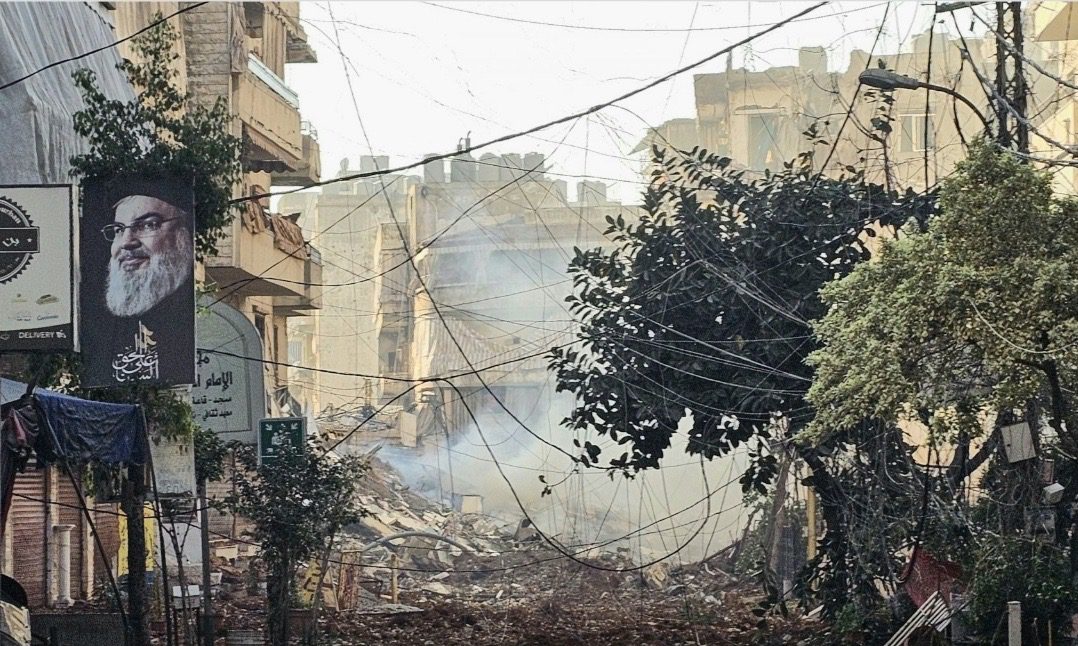
Israel resumed large-scale military operations in Lebanon on 2 March 2026. Its stated target is Hezbollah. Its trigger: rockets fired into Israel by Hezbollah following the killing one week earlier of Iran’s Supreme Leader, Ayatollah Ali Khamenei, declared as Hezbollah’s red line. Israel’s goal, already revised, began as the eradication of any possible threat to it for the foreseeable future, from Hezbollah and its sympathizers. Its impact is the obliteration of everything that makes life possible at least south of the Litani River, the deepening of the country’s political crisis, a humanitarian crisis of unprecedented proportions, and a possible death rattle for the state.
in the last month, Israel has killed more than 1,300 people including, according to UNICEF. 10 children a day. Perhaps worse than the toll itself is the logic behind the assault, which appears intended to prohibit any chance of peace – except a Carthaginian peace at Israel’s diktat.
The country of Lebanon is in the eye of three convergent storms. It’s the epicenter of World War X and an exemplar of its most terrifying logics taken to an extreme.
The first storm has been there for decades: a formalized, entrenched version of a political marketplace. Lebanon’s constitutional system distributes the rents of the state by confessional franchise. It’s a hard system to manage: it can only deliver peace if the distribution is both generous and seen to be fair. It became unmanageable as public revenue collapsed while monetized political competition intensified. The second storm is Lebanon’s entanglement in a regionalized proxy war in which Iran, Saudi Arabia and Syria, as well as Israel treat Lebanon’s sectarian formations as instruments of their own strategic competition. Third is Israel’s totalizing counterinsurgency – the Gaza doctrine.
Lebanon’s confessional order — formalized in the 1943 National Pact, adjusted at Ta’if in 1989 — allocates state rents to the patronage networks of each community’s za’im, its political boss. Most political marketplaces are informal; in Lebanon it is in the constitution itself. The Lebanese state was never a public institution corrupted by private interests – it was from the outset a structure for factional interests to collude in running a public institution as their joint extraction mechanism. The warlords of the 1975–90 civil war graduated into cabinet ministers; checkpoint bandits became crony capitalists. The Assad regime in Syria then imposed itself as the apex patron — taxing the political brokers, selecting the winners, extracting a cut from every deal — until its forced withdrawal in 2005 removed the boss without replacing the system.
Meanwhile, Beirut became one of the main nodes for illicit international finance. The kleptocratic piping for ill-gotten gains and political money ran through the country. This had the ironic impact that the 2008 financial crisis saw an increase in bank deposits in the country as dark money fled from major markets. But that consolidated Lebanon’s impasse: there was more political finance and the government did nothing to alleviate the parlous state of public finance. In fact between 2005 and 2017 there was no budget passed.
Prime Minister Rafik Hariri’s fusion of private fortune and public borrowing, the Central Bank’s engineered dollar peg, the deposits that became worthless when confidence evaporated in 2019 — all was akin to a political Ponzi scheme. In due course, public revenue and state capacity, already weak, collapsed. At the same time, political rivalry funded by external patrons flourished. By 2023, Lebanese soldiers earned less than $40 a month and many took on other jobs to feed their families. The suggestion that this army can disarm Hezbollah, however much it wants to, is worse than fanciful. It is dishonest, untruthful.
The government was caretaker, the presidency vacant, the budget meaningless. The 2020 port explosion — 2,750 tons of ammonium nitrate stored unsafely for six years with official knowledge — killed more than 200 people, wounded 7,000, and damaged more than half of Beirut. Every attempt at accountability was blocked.
Amid this vacuum, Hezbollah has built an effective political party, winning seats in parliament and ministers in government, along with social services that parallel, and in places outstrip, the state’s own. It emerged from Israel’s 1982 invasion against the Palestine Liberation Organization, was nurtured by Iranian trainers and money, and expanded as the Lebanese state’s contracted — building hospitals, schools, and welfare networks (not exclusive to Shi’a) where the state had ceased to function. And with that, a committed social base.
This was funded by local taxes, commercial enterprises (licit and illicit) and Iranian transfers, the last deepening Lebanon entanglement with regional destabilization – the second storm. Hezbollah had to tread a fine line between following the diktat of its patron and protecting its own. Its leaders’ decision to fight in the Syrian civil war on the side of the Assad regime – keeping its supply lines to Iran open but committing horrendous abuses while doing so – changed it from being primarily a Lebanese resistance movement into a sectarian mercenary abhorred by most Syrians and by a large part of Lebanon’s Sunni community. That was the beginning of the decline of its legitimacy among the wider Lebanese population. It was also a fatal tactical blunder – it was in Syria that Hezbollah was reportedly penetrated by Mossad, opening the door to Israel’s pager-assassination operation of September 2024 that killed more than 40 people and injured thousands, including old people and children.
The third storm is Israel’s. The Benjamin Netanyahu government is on a region-wide offensive. It is in a state of permanent war against the so-called ‘Axis of Resistance’ – portrayed as simultaneously an existential threat and a constellation of weak actors that can be destroyed with well-aimed blows. For this Israeli government, negotiation and deal-making are tactical. What is strategic is destroying the economic and social infrastructure of the countries and peoples in its gunsights.
Israel is attacking Lebanon with a methodical ferocity that goes beyond what has been called the ‘Dahiya doctrine’, so-named in the 2006 war for the southern districts of Beirut where Hezbollah had its headquarters. That year’s ruinous attack on Dahiya, a sprawling, densely populated area composed largely of Shi’a displaced from the south, was not only an act of deterrence. It was tutelary violence – expressly designed to teach Israel’s enemies a lesson.
It’s a wager that fear will be stronger than hatred. It didn’t work then and it won’t work now. This should surprise no-one. In 1982, Israel launched ‘Operation Peace in Galilee’ to destroy the PLO in Lebanon. Prime minister Menachem Begin told the Knesset the campaign would be over within 48 hours. The Israeli Defense Forces ended up staying 18 years. Hezbollah was born from that.
More than 40 years later, Galilee is still under fire – from different, bigger guns.
Since 2000, instead of military occupation, Israel adopted the practice of ‘mowing the lawn’ – repeated, unopposed assassinations of members of the political and military resistance.
Israel’s 2006 ‘Operation Just Reward’ was brief – the IDF didn’t stay – but didn’t succeed in cowing Hamas or terrifying its supporters into submission.
It’s a general lesson from counter-insurgency: operational successes don’t add up to strategic victory. People hate those who are killing them with missiles and airplanes, forcing them from their homes, deploying starvation as a weapon of war. Israel’s way of war generates the conditions for indefinite war. When the grass is cut to the roots, the weeds that grow back are hardy and drought-resistant.
Today, we are hearing senior Israeli figures make explicit comparisons to the destruction visited on Gaza after October 7, 2023. The IDF has struck eight bridges over the Litani River, isolating southern Lebanon, and the western Bekaa valley, from the rest of Lebanon. It is signalling that those who are forced out may never return. Dahiya is emptying of its half-million residents. It’s the obliteration doctrine.
Israel is also playing on the sectarian divides, turning Lebanese against one another. It’s hoping that Lebanon’s other communities – Sunni Muslims and Christians – will so hate the Shi’a for bringing Israeli wrath down on their country, that they won’t object to the massive destruction visited on their towns and cities today.
This is a logic of permanent subjugation. Not so much cutting the grass as pulling it up by the roots.
Shakespeare’s Macbeth, having killed his way to power, wearily confesses, ‘I am in blood / Stepped in so far that, should I wade no more, / Returning were as tedious as go o’er’.
Netanyahu’s Israel has trapped itself in a river of blood, and is now unable to reach either bank. Yet it seems set on escalation, apparently believing, yet again, that this time is somehow different.
Israel’s wars are widely supported at home. No-one in government – and very few in Israel as a whole – is contemplating peace.
To make peace, there’s only one option: talk to the enemy. In every successful peace process, the negotiators on each side find that their adversaries are human beings too – that there are men and women across the table who have a shared humanity.
The deliberate ‘targeted killings’ of enemy commanders, politicians, journalists, doctors and ambulances – the list is long and growing longer – makes war personal. These are extrajudicial executions, in open defiance of international law whatever the uncritically-accepted moniker suggests. Commanders in war must of necessity take risks and accept that those not directly involved in combat will suffer too. But precision killing from afar, dignified as ‘targeted killing’, violates the deepest precepts of the warrior’s honor. Like landmines, it is a coward’s weapon. When the other side does it, Israel and America call it terrorism.
Personalized killing dehumanizes both killer and target. When killing is accompanied by denigration, when it is done systematically and repeatedly, it violates any sense of common humanity – and with it any hope for peace.
Israel and Hezbollah have fought many times over forty years. In October 2023, Hezbollah began firing missiles into Israel after Hamas broke out of the Gaza siege, killing civilians well as soldiers. The conflict escalated twelve months later, until the two agreed a ceasefire in November. But that truce was not a step toward peace, just a pause for both sides to regroup. Hezbollah was damaged but unbowed – and now rebuilt, despite a year of Israeli attacks, unanswered, on southern Lebanese towns, villages and fields. Hezbollah is showing much greater capabilities for sustaining resistance than was anticipated in Tel Aviv or Washington.
The Lebanese state, which in theory should be responsible for the security of its entire territory, is powerless. It is being reduced to something akin to the Palestinian Authority in the West Bank – rendered incapable, denied the support it so badly needs, and then blamed for doing too little by those who themselves did little.
The cycle resumed again on March 2.
Lebanon’s leaders are calculating how to survive in the tiny political space that remains. All they can do is hang on, hoping that there may be a chance to revive the dream of Lebanon as a cosmopolitan democracy, an island of civility in a sea of intolerance – Arab and non-Arab. Lebanon’s citizens are cowering as the drones circle and the missiles strike. Approximately 1.3 million people have been made homeless in a few weeks – about a third of them children. Amid rains that are at times torrential, only a fraction are in shelters.
They are trying to survive day to day.
And in America and Europe, indifference reigns. The misery of so many, the ruination of a country, passes with scarcely a murmur of international concern, let alone outrage.
On Easter Day, just as church bells were ringing in celebration, Israeli jets screamed across the skies of Beirut, unleashing their lethal munitions. Hope dies last in war, but Lebanon’s is barely surviving.