As food security experts worry about a possible emerging global food crisis next year, following an El Niño that is expected to unfold. El Niño is a periodic phenomenon characterized by warming of surface waters in the central and eastern tropical Pacific Ocean, which disrupts atmospheric circulation patterns and triggers cascading weather effects — including droughts, floods, and temperature extremes — across much of the globe. The historic impacts of such phenomena show how when political forces converge with the weather impacts may lead to concerning results.
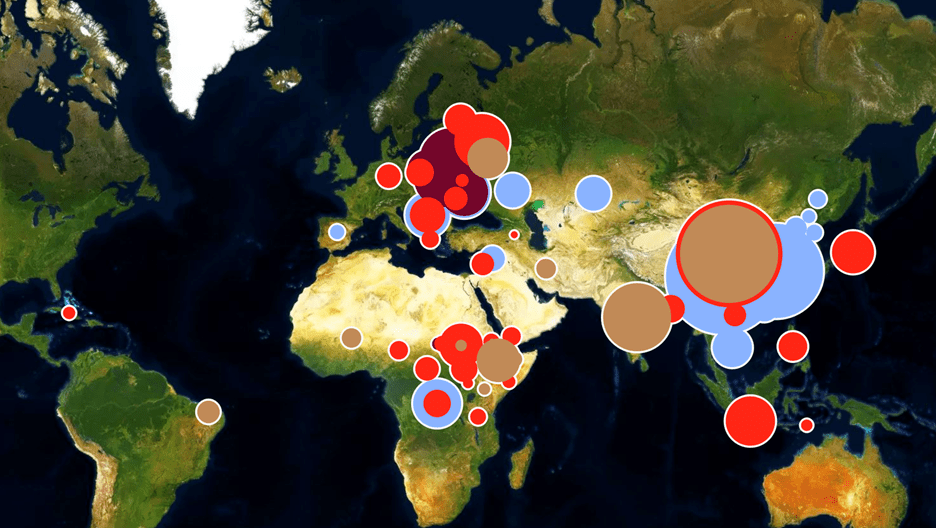
Now, meteorologists predict an El Niño event by the end of this year, and many forecast that it will be the most severe on record. Here we look to The World Peace Foundation historic famines dataset to try and understand the possible scope of the impact. The interactive map based on the dataset is available here.
This blog covers the events of 1876-78 and 1896-1901, that Mike Davis has called “Late Victorian Holocausts”. Both were triggered by an El Niño, which typically causes droughts across the Sahel and Horn of Africa and South Asia, and both droughts and floods in China.
This figure shows mortality in great famines since 1870. There are six big peaks over those 156 years. The first two peaks are these El Niño famines.
Mortality in great famines 1870-2023
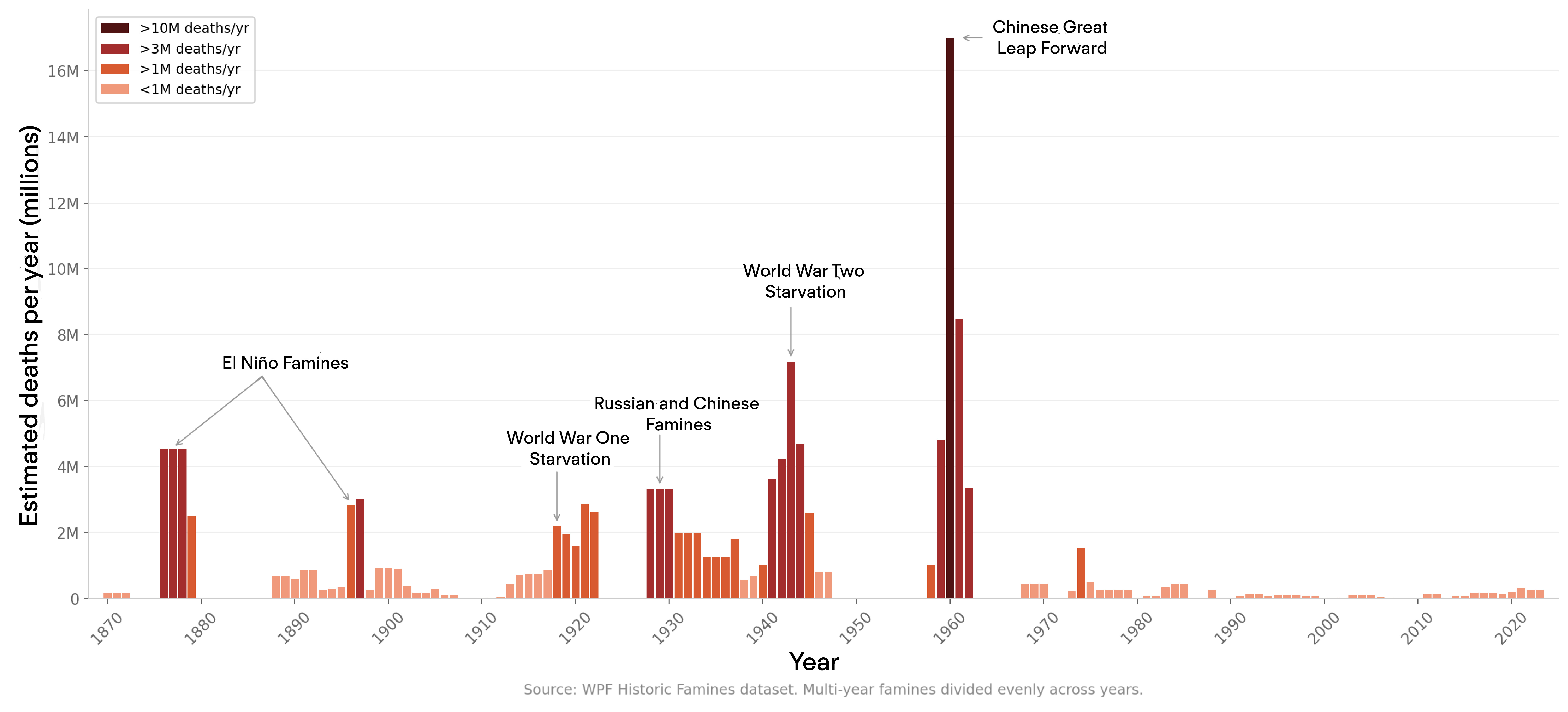
The 1876-77 El Niño was possibly the most severe on record. It caused widespread crop losses around the world and triggered famines in China (9.5 million estimated dead), India (6.1 million), north-eastern Brazil (500,000) as well as other events that didn’t meet the ‘great famines’ threshold of 100,000. As is the nature of catastrophic famines – those that kill a million or more – the initial shock reverberated over several years. This natural disaster came on the back of severe colonial exploitation in India and the chaos in China in the aftermath of the Opium Wars and the Taiping rebellion – without these prior conditions, the loss of life would undoubtedly have been far less.

The colonial response to mass starvation in India was so scandalously inadequate that it led to the first Indian “famine codes” that codified the authorities’ responsibilities for relief. But the measures demanded were minimal.
A second severe El Niño struck in 1896-97, causing another round of famines. And before the afflicted communities could begin to recover, they were struck by the effects of a shorter, less severe, El Niño in 1899, enough to trigger a second round of calamities. The demographer Tim Dyson called these “bang-bang famines” – a case where one disaster contributes to another. They’re so close together that the two peaks merge in the timeline and we have combined them for this map.

It was in the wake of these famines in colonial India that the authorities expanded the famine codes and made them much more effective.
The El Niño events of 1972 and 1983 each caused crop failures across the West African Sahel, Sudan, Ethiopia and Somalia, as well as India and Bangladesh. The African famines of those years led to the creation of an international apparatus for famine early warning and response, that lasted half a century which is falling apart today.
What will be the impact of a severe El Niño today? Even if its meteorological scale may be possibly on par with the 1878 event; its food security outcomes will be very different.
The countries hardest hit 150 years ago – China, India and Brazil – are no longer vulnerable to acute food insecurity. But we should be worried about other parts of the world, such as the West African Sahel, the Horn of Africa, and Yemen.
Since the Trump Administration closed USAID and with other aid donors scaling back, it’s unclear whether the warnings will be heeded, and if calamity will be prevented.