The worst famine in recorded history was the Great Chinese Famine. Between 1958-1962 an estimated 36 million people were killed by entirely man-made starvation. In fact, the policies that lead to the catastrophe can draw back to the decision of a single man, Mao Zedong, the biggest mass killer through starvation in history.
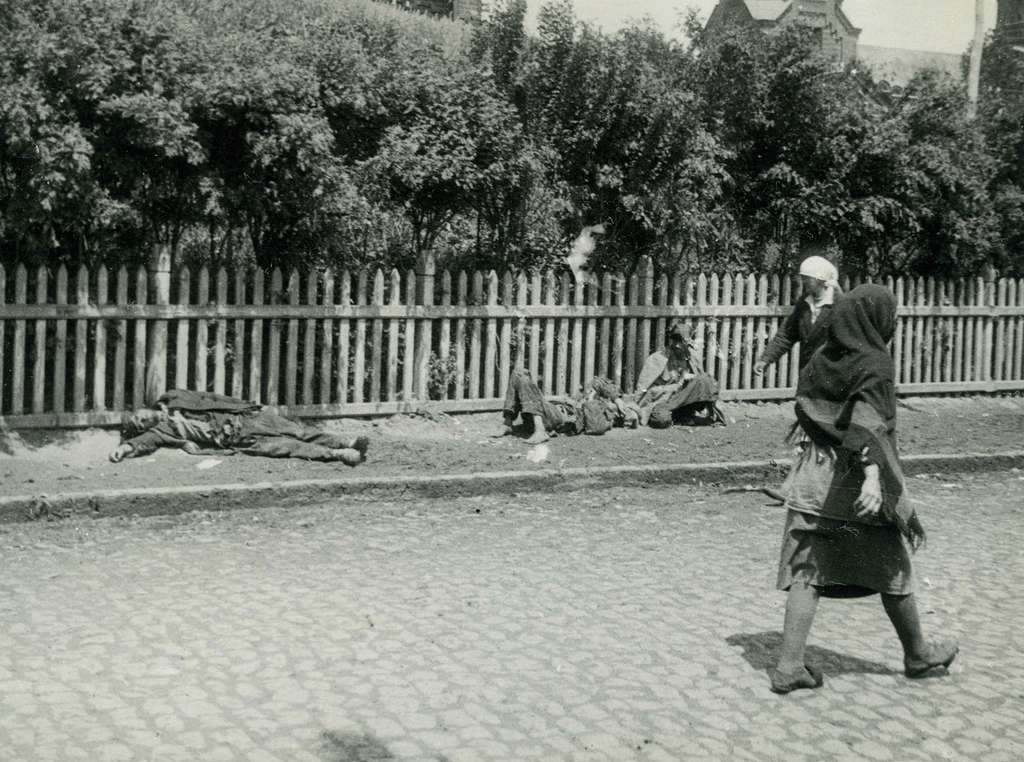
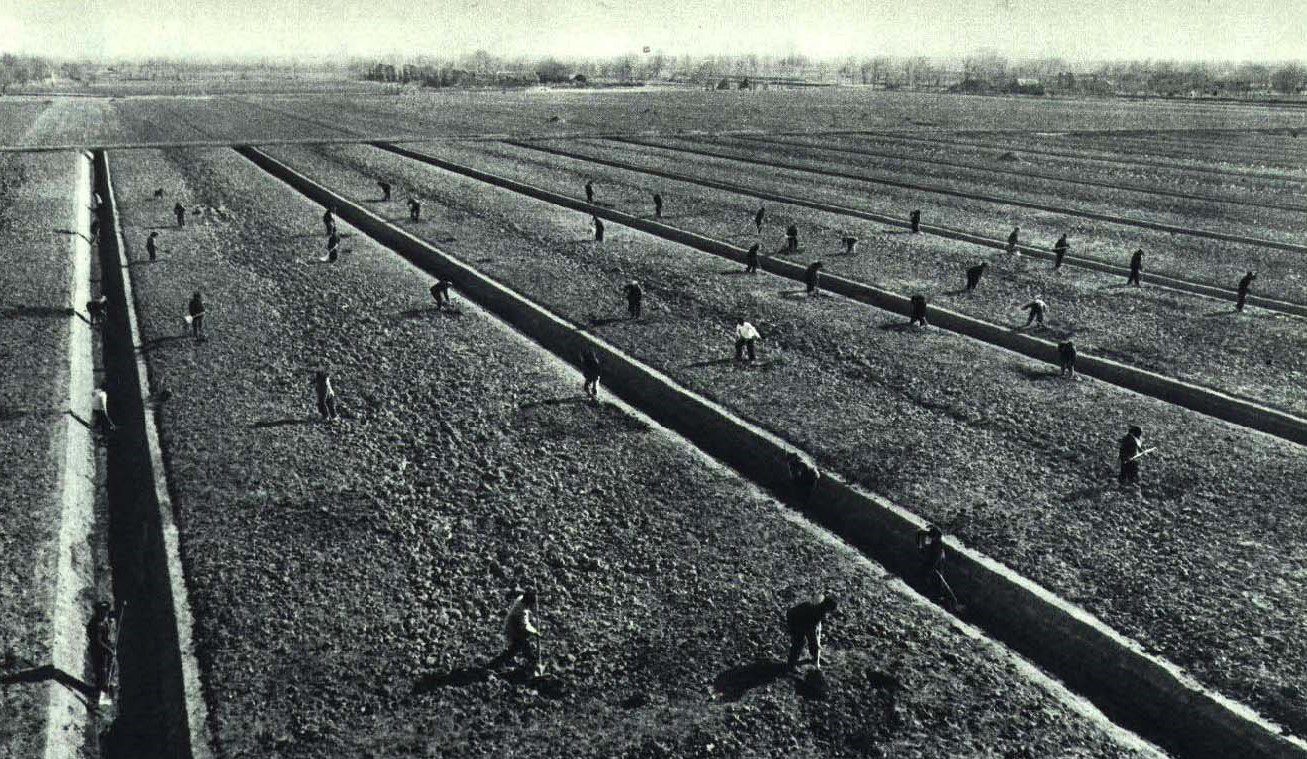
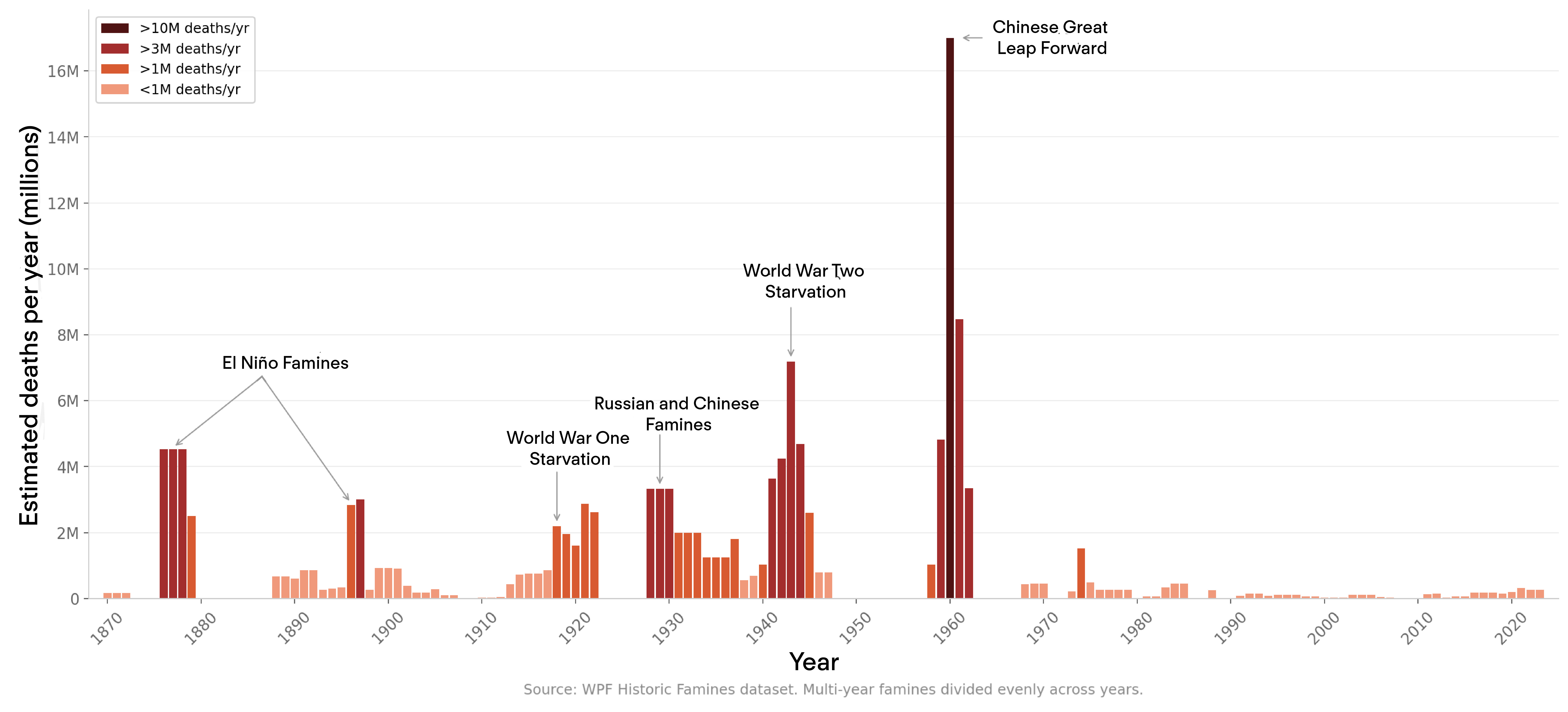
Though it is by far the most fatal famine, it’s all-but-impossible to find any photographic record of it at all. Instead, the famine is represented by propaganda pictures – and in the spikes and circles of data visualizations. It’s the biggest spike on the graph of historic famine mortality.
Mortality in great famines 1870-2023
It’s the biggest circle in the map of mortality in famines since 1870. The blue color identifies it as a policy-made famine: brown circles are those triggered by natural calamities; red circles are caused by war; dark red represents cases of genocidal starvation.

And this graphic underlines just how huge it was compared to the world’s other catastrophic famines. It even surpasses the deaths from famine during the entirety of the Second World War and its aftermath, which added up to 27 million.

If we break the famine down by province, the death toll in Sichuan alone, 10.3 million, places it as the single biggest killing famine of the last 150 years. The second worst-hit province, Anhui, comes in at number 4.
| Rank | Deaths | Date | Famine |
| 1 | 10,300,000 | 1958–62 | Great Leap Forward – Sichuan, China |
| 2 | 10,000,000 | 1928–30 | Famine in northern China (Gansu, Shaanxi, Shanxi, Henan, Shandong, Hebei) |
| 3 | 9,500,000 | 1876–79 | Great North China Famine |
| 4 | 7,000,000 | 1958–62 | Great Leap Forward – Anhui, China |
| 5 | 6,100,000 | 1876–78 | Indian Great Famine |
Numbers 3 and 5 on the ranking were caused by the 1876 super El Niño; number 2 was triggered by drought and locusts but exacerbated by warlordism and economic crisis. By contrast, the 1958-62 had a singular, man-made cause. In 1958, Mao Zedong launched the ‘Great Leap Forward’ with the goal to industrialize the country with the lofty goal to surpass Great Britain’s advancement from the industrial revolution and become the leader of the Communist world through collective farming and backyard steel production. Peasants were pushed into people’s communes, private cooking was banned, and communal kitchens were to feed tens of millions of laborers who previously worked in agriculture.
While forced collectivization spectacularly failed to produce enough crops, and villagers slaughtered their pigs and other livestock rather than surrender them to party control, such was Mao’s diktat that local officials were compelled, not only to praise the policy, but to report inflated harvest numbers. In fact, they competed in sending in fantastical reports of abundance, fearing retribution and hoping for advancement. What happened next was that the state took its quota of grain based on these imaginary numbers, often leaving people with nothing. By spring 1959, the famine had set in, and more than twenty-five million people were reported to be without food after one year. Many cadres knew the reality; none dared challenge Mao. Only in 1961 did the leadership begin to reverse its policies, but it was far too late.
This is the map of famine deaths across China during those years.

Astonishingly, so complete was the secrecy surrounding this catastrophe that it was hardly known about for decades. Within China, villagers often believed that it was only their locality, or district, that suffered. The rest of the world knew nothing – to the contrary, China was known for its success in reducing endemic diseases through “barefoot doctors” and was heralded as a success.
The famine was the Chinese Communist Party’s most shameful secret, it is unsurprising that the starvation is still shrouded in a great silence. Across the country, only a smattering of families have memorialized the victims. However, after years of painstaking work, much of it in secret, the catastrophe has been documented by Yang Jisheng, whose book Tombstone is the definitive account. Why this matters for anyone working on famine and peace, Yang puts better than we could:
“Human memory is the ladder on which a country and a people advance. We must remember not only the good things, but also the bad; the bright spots, but also the darkness. The authorities in a totalitarian system strive to conceal their faults and extol their merits, gloss over their errors and forcibly eradicate all memory of man-made calamity, darkness, and evil.”[1]
[1] Jisheng, Yang. Tombstone : The Great Chinese Famine, 1958-1962, Farrar, Straus & Giroux, 2012. Page 10.