Famines vary. Even in conflict-stricken agrarian societies in sub-Saharan Africa, they can unfold at different speeds and with different patterns. While actual famines, classified as such by the Integrated Food Security Phase Classification (IPC) thresholds are still relatively rare, near-famine crises are increasingly frequent, with nearly a dozen cases reviewed for famine conditions since 2022. There are sound reasons for using standardized metrics for assessing the scale of need—but treating all famines as the same can contribute to failures in early warning systems and response mechanisms.
This blog post draws on a newly-published study by Daniel Maxwell and six co-authors, “Trajectories into Famine: Observations of Patterns and Processes“. It applies the famine systems model developed by Paul Howe to recent famines in Somalia and South Sudan. The relatively good quality data permits us to map out several pathways by which populations descend into famine—or avoid doing so.
The main finding is that the shape of the trajectory matters less than whether and when a trajectory into famine starts. A second is that the study confirms that famines should be viewed as systems with interacting parts, not simply as events, and that this perspective can offer new insights into the trajectories of crises. The crucial policy takeaway is that if it is possible to identify the onset of a famine trajectory (as opposed to simply warning of worsening food insecurity), it should enable earlier and more effective interventions to prevent famine.
Based on the data from two cases in each of Somalia and South Sudan, the paper identifies three recurring archetypes of trajectory, including two near-miss variants.
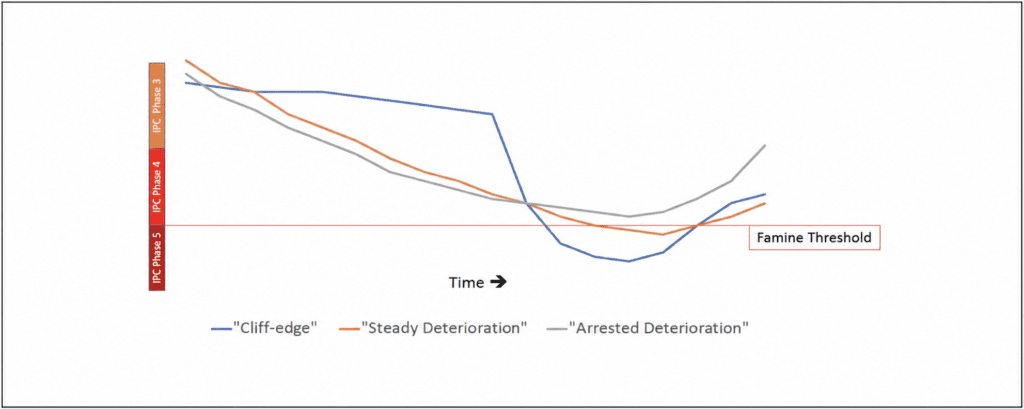
The first is the “cliff edge” trajectory. Somalia in 2010–11 is the paradigm case, and numerous historical famines share the same shape: conditions deteriorate rapidly over a short period, with a steep descent into famine with few plateaus or partial recoveries.
The second is “stepwise deterioration”—a more graduated descent in which conditions worsen in discrete steps, with partial stabilizations along the way. This comes in two versions. Unity State, South Sudan in 2017 shows a stepwise trajectory that crossed the IPC Phase 5 threshold and qualified as famine. Somalia in 2017 is the near-miss variant: conditions followed a stepwise pattern, approached the famine threshold, but were arrested by a significant scale-up of humanitarian response mobilized in time.
The contrast between these two—similar pressures but different outcomes—provides a salient lesson about how response timing interacts with trajectory type.
The third is the “hybrid” or “double dip” trajectory. Pibor County, South Sudan in 2020 is the primary example. Here conditions deteriorate, partially recover or plateau, then deteriorate again in a jagged pattern. Again, there is a version in which the famine threshold is crossed, and another in which it is not. The double-dip structure is particularly dangerous for early warning because the partial recovery in the middle can generate false confidence that the crisis is resolving, when the underlying drivers remain active.
Many crises that look in their early stages like the onset of a famine trajectory do not become famines. Instead they level off, are arrested by response, or remain in chronic emergency at IPC Phase 4 without crossing the Phase 5 threshold. The near-miss cases are as analytically important as the breach cases. Understanding why Somalia 2017 was a near miss and Unity 2017 was not illuminates the conditions under which the same trajectory leads to famine or does not.
This reframing matters for how we use the current metrics for assessing acute food insecurity and famine. IPC phase classifications are cross-sectional, measuring severity at a point in time. The trajectory framework draws attention to the dynamics of deterioration, not just its current severity.
The three archetypes have different implications for the window of opportunity for intervention. Cliff-edge trajectories leave little time once deterioration begins; the Somalia 2011 case is a reminder that even when warning was available, access constraints and institutional delays meant response arrived too late and an estimated 260,000 people perished. Stepwise trajectories offer more time but risk generating false confidence during the stabilization phases. The difference between Unity State in South Sudan and Somalia in 2017 turned on whether that window was used. Double-dip trajectories present a third risk: premature scale-down of response during the partial recovery in the middle of the pattern, precisely when continued vigilance is needed.
Together, the three archetypes make a practical case for differentiated anticipatory action strategies calibrated to trajectory type, rather than a one-size-fits-all response triggered only when a crisis reaches Phase 4 or Phase 5. A cliff-edge trajectory calls for pre-positioned resources and fast release mechanisms. A stepwise trajectory calls for sustained monitoring through apparent stabilizations. A double-dip trajectory calls for caution about classifying a crisis as being over.
Other contemporary crises that have approached famine, dipped in and out of famine, or plunged populations chronically into famine—such as Sudan, Yemen and Gaza—may show further variants that should be examined. There are many populations in chronic IPC Phase 4 “emergency” conditions, most likely with aggregate excess mortality mounting year by year. The question of trajectories into famine is a consequential issue, and this paper contributes to sharpening our framework for making key humanitarian judgement calls.