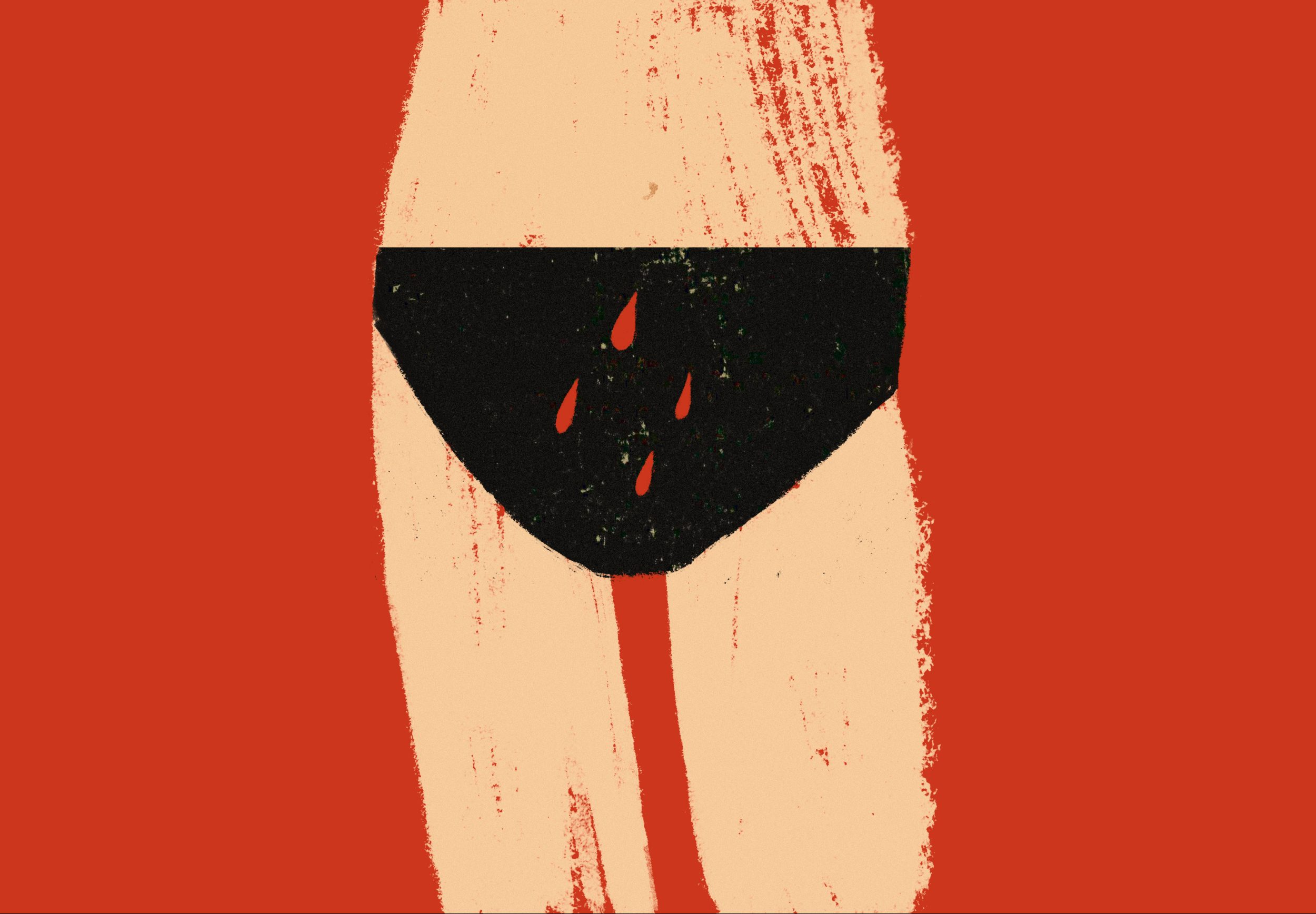
In a war where blood can mark you as a suspect, girls face a cruel reality: their bodies become proof of survival. In Syria, a sanitary pad can be a lifeline, and a luxury. Girls bleed in silence, hiding pain that the world refuses to acknowledge.
During a chaotic evacuation of civilians in Adrah, an area in rural Damascus, I slept in a Red Crescent car. I was helping SARC volunteers respond to fighting spreading in 2012, after the Syrian revolution.
I woke up in a pool of blood. It took me a few minutes to realize it wasn’t mine, and to calm myself down. I told the male colleague who had spent the night in the driver’s seat to pass me whatever tissues he had.
He blushed. Most volunteers were younger than me, and I had trained them in emergency response, security management, and paramedic work, officially and unofficially. They had never been in a war. My experience helped them navigate the chaos, and despite the dangerous conditions, we built trust and friendship.
He reached for the aid boxes beside him and handed me a pack of sanitary pads in pink packaging, barely keeping his gaze from the blood. I laughed out loud.
“It’s not me! It’s probably the young injured man we carried yesterday. I couldn’t see all his injuries in the few minutes we had.”, We were breaking the Syrian law by having him in the car.
This did not relieve his embarrassment. By that time, injuries in the war, though hospitals still worked, were deadly. Anyone coming from “areas of trouble” risked execution, detention, or disappearance. Blood, in that context, was evidence: proof of involvement in anti-government protest, or simply of living in the wrong place at the wrong time.
I told him that in my experience in Iraq, sanitary pads were a privilege of refugees, not the internally displaced. He stayed quiet. He had witnessed disputes with local and international authorities over whether menstrual products should be considered “essential” at all.
The camp we visited the day before consisted of families taking shelter in naked cement structures, unfinished, cold, exposed. Families arrived exhausted, carrying what little food they could, often going hours or days without proper meals. Hunger made every task, walking, waiting, even bleeding, a sharper, heavier struggle. People preferred these structures to tents provided by INGOs, which ironically often ended up as makeshift covers for soldiers’ checkpoints. Both the government and displaced people refused the tents, for very different reasons. The idea of tents invoked the continuous trauma of the displaced Palestinians, and their ever-returning dispassion.
Within hours of the ‘camp’s’ establishment, SARC volunteers tried to organize aid. But the government forces erected a security post beside ours. Everyone, men, women, and children, was forced through the security checkpoint after registering for aid, a hastily enclosed and private space, while our aid point remained exposed. The voices of interrogations and beatings often drowned out conversation, as armed men inspected and questioned every action, including the disposal of menstrual pads by women and girls.
Some volunteers were losing control. Arguments flared that could have ended with arrests or closure of the aid point. I had to step in, mediate, and manage the masculine egos on the “battlefield.”
Then a sixteen-year-old girl approached, her mother behind her. She waved a pack of sanitary pads in my face.
“We are five! How is this going to do? Where am I supposed to change?”
Her mother, face full of shame, tried to silence her. “We will figure it out,” she whispered, anger and despair heavy in her voice. I calmed the mother and looked at the brave girl.
“You are absolutely right,” I said. “I will figure it out.”
But I didn’t.
By 2015, I was arrested by the Syrian regime for three weeks for providing medical aid to government hostile personnel, ‘terrorists’ according to the Syrian law. When I asked an officer for pads, defeated, he replied with disgust:
“You will figure it out, Dr.”
Some detention centers reportedly had period products, according to past detainees: but the men there wanted to break me or according to them ‘rehabilitate me’. Even when pads were sometimes available, food remained scarce. Bleeding while hungry was a cruel layering of deprivation that stripped dignity from every moment.
Menstrual products, privacy, and dignity are rarely considered in humanitarian aid, despite being central to survival and safety. In Syria, as in Iraq, war and state control transform the most intimate aspects of life into tools of violence. Blood becomes evidence, a marker of suspicion, a source of shame. Hunger compounds the humiliation and vulnerability of every girl and woman trapped in conflict.
International humanitarian narratives often frame their interventions as neutral, impartial, or even protective, yet they frequently erase the lived realities of women and girls. The aid system, like Western feminist rhetoric in past conflicts, often prioritizes abstract notions of “essential aid” or “protection” over the actual, immediate needs of those it claims to serve, including access to menstrual products, privacy, and food.
The politics of aid and the priorities of war make menstruation a battlefield in itself. Girls and women are left to navigate humiliation, neglect, and danger, sometimes from those meant to protect them.
If what I experienced is not gendered violence, then what is?