Three years ago, on April 15, 2023, the Rapid Support Forces (RSF) militia launched a coordinated military assault across Sudan, marking the eruption of a war that has since become the world’s largest humanitarian catastrophe. Three days earlier, the RSF militia had already deployed troops to besiege the Merowe Air Base in northern Sudan, decisively stripping away any ambiguity about who started the war in Sudan. As this grim anniversary approaches, one fact demands to be stated plainly: This war erupted within Sudan, driven by its internal structural dynamics, but it is now being systematically sustained, prolonged, and intensified primarily through external intervention. Sudan is not collapsing, it is being collapsed.
What is routinely described as a civil war, a contest between rival military factions compounded by ethnic tensions and economic breakdown, is a dangerously incomplete framing. It obscures the central driver and, in doing so, shields those responsible for sustaining it.
This is not an ideological war, nor is it primarily ethnic in its logic. The same Janjaweed militiamen who carried out ethnic cleansing during the Darfur massacres of 2003–2008 in service of President Omar al-Bashir’s Islamist regime are now repeating those atrocities across Sudan — targeting their former victims and everyone else — while this time fighting against the government. What drives this conflict is not identity but smuggled gold, logistics corridors, and control over the Red Sea. These are not contextual factors. They are the architecture of the war.
The most consequential and least addressed actor in this architecture is the United Arab Emirates. Abu Dhabi has provided the RSF with weapons, political cover, financial networks, logistics, and media support, transforming it into a highly functional proxy force. To describe this as mere support, understates the reality: in operational terms, the RSF is fighting the Sudanese state on behalf of the UAE.
The material motives are clear. Sudan sits at the intersection of high-value strategic assets: vast gold reserves, the majority of which are smuggled into UAE markets through illicit networks; some of the most fertile agricultural land on the continent (Sudan’s 112.6 million agricultural hectares alone is roughly 13.5 times the UAE’s entire territory); and under-utilized Red Sea coastline along one of the world’s most critical maritime corridors. Controlling the passage from Yemen’s Aden port through the Horn of Africa and into the Suez Canal has been a central UAE objective for years. Sudan is not a side conflict for the UAE. It is a prize.
This is seen with the pattern of UAE intervention which is continuous and adaptive. Even as the UAE itself has faced Iranian strikes in the current Gulf escalation, its engagement in Sudan has not de-escalated — it has intensified. Arms supply networks have been rerouted through Ethiopia and the Central African Republic. A new eastern front opened in Sudan’s Blue Nile state, aligned with Emirati pressure on Ethiopian Prime Minister Abiy Ahmed, who was summoned to Abu Dhabi at the height of the regional crisis to secure his cooperation. The sequence — pressure, alignment, corridor activation — reveals a coherent operational logic: diplomatic leverage, logistics, and proxy deployment synchronized to expand the geography of Sudan’s war.
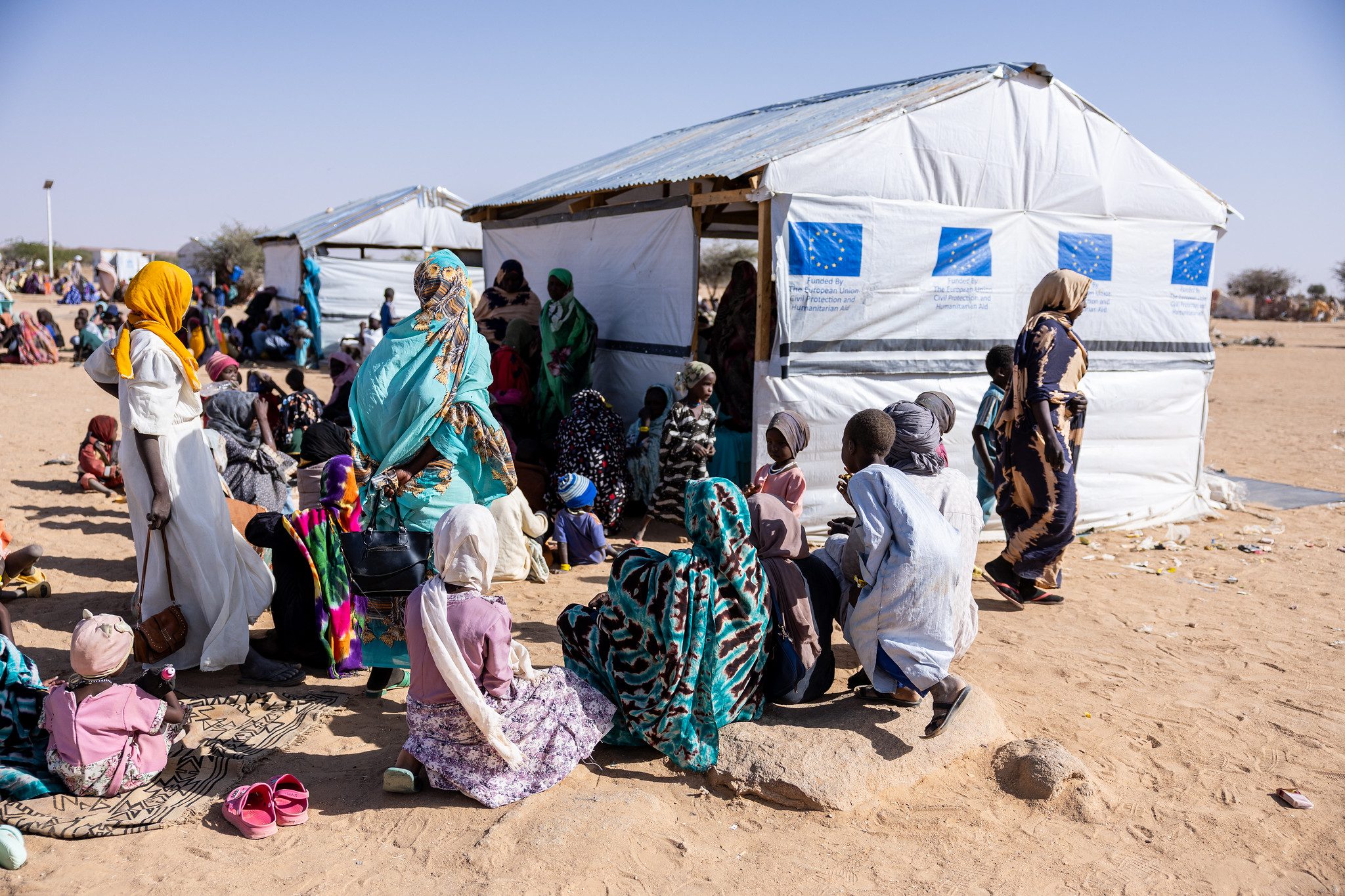
Inside Sudan, the consequences have been catastrophic. Famine was not a side effect of the war — the RSF wielded it as a weapon. In al-Fashir, Kadugli, and other besieged cities, civilians were deliberately cut off from food, medicine, and escape routes based on their ethnicity. The RSF encircled entire cities, emptied markets, blocked aid convoys, and dug trenches — not as defensive lines, but as death traps. Families in al-Fashir were reported boiling animal skins to survive.
The international response has been structurally inadequate and that is a charitable description. The use of passive voice to describe the humanitarian crisis, as though no one is responsible; the reflexive appeal to “two parties” to manufacture false equivalence; the failure to act on options like airdrops of aid that the Sudanese government pursued alone in the besieged al-Fashir with whatever capacity it had — none of this reflects informational failure. It reflects political complicity. The US, UK, UN, and other actors were aware of the RSF’s weapons supply chains and those running them, as documented by UN Panel of Experts reports, U.S. governments’ briefings, diplomatic leaks, and independent investigations but geopolitical calculations and economic relationships have produced a system where accountability is deferred, ambiguity maintained and silenced prevailed.
This complicity extends beyond silence. The UK worked to suppress criticism of UAE involvement within diplomatic circles, censored mass atrocity warnings from early warning reports, and made efforts to block the presentation of evidence at the UN Security Council. Emirati narrative operations run deeper still: UAE-owned media platforms set agendas and recode events in politically convenient language; coordinated digital networks flood information spaces and manufacture consensus; and segments of expatriate Sudanese political elites provide normative cover, reframing the war through external ideological lenses to serve their own return to power.
Central to this narrative architecture is the recasting of the current Sudanese state as an extension of political Islam — a framing that deliberately erases the 2019 revolution, in which Sudanese citizens toppled the al-Bashir regime connected to that very order. The paradox is stark: a society that rose against an Islamist-authoritarian system is now confronted with a militia — itself a byproduct of that same order — perpetrating more expansive and systematic violence. Yet a manufactured political narrative is being amplified to justify alignment with the militia. Sky News Arabia – A UAE-owned news channel- was exposed for its attempts to water down the massacres in al-Fashir. History is not merely distorted here. It is weaponized to legitimize violence and absolve its sponsors.
There is no meaningful pathway to peace in Sudan that does not address the external drivers of the conflict. Two conditions are necessary for ending this war. First, the dismantling of foreign intervention networks — weapons flows, financial networks, and political protection — that sustain non-state actors. As long as these persist, the war will reproduce itself regardless of internal dynamics. Second, the defeat of the political project embodied by the RSF: not simply an armed group competing for power, but a militia structure that has demonstrated systematic patterns of racially motivated mass violence, including acts recognized as genocide, in service of a foreign agenda entirely disconnected from any Sudanese national interest. Its continued existence as an autonomous force is incompatible with any stable political order.
Beyond these conditions lies a longer-term imperative: the restoration of Sudanese agency. The demand for civilian governance is not externally manufactured. It is the product of decades of struggle, culminating in a popular revolution that briefly opened the possibility of democratic transition — a trajectory undermined by the same external forces that now sustain the war. Reclaiming it requires that Sudanese people — those who marched in 2019, who resist today, who live under siege and displacement — become the agents of their own political future, not objects of competing foreign projects.
Sudan is not an isolated case. It is an acute manifestation of a rising pattern: the use of proxy forces, economic leverage, and narrative manipulation by regional powers to reshape fragile states. If left unchallenged, this model will replicate across the Sahel, the Horn of Africa, and beyond — striking at the foundations of independent statehood and failing, in the UN Charter’s own words, to “save succeeding generations from the scourge of war.”
The choice facing the international community is therefore not limited to Sudan. Either international law is applied universally — including to wealthy and influential states — or it ceases to function as law altogether. Three years on, Sudan remains the test case for whether engineered state collapse, driven by external actors and sustained through impunity, will be normalized as an instrument of foreign relations.