There’s a gap between what experts know about conflicts in Africa, and what the established datasets record. That gap is particularly acute when it comes to external involvement in wars – the foreign role in stoking conflicts in Africa is under-counted, and that contributes to analytical gaps and policy errors. Eight years ago, we developed the Transnational Conflict in Africa Dataset (TCA) to remedy this, by combining and revising several existing datasets – notably the Correlates of War (COW) data, and the Uppsala Conflict Data Program (UCDP) conflict dataset. We showed that transnationality is a major feature of armed conflicts in Africa and that most so-called “civil wars” in Africa are more correctly described as internationalized internal conflicts.
Since then, the UCDP has developed its own dataset on external support to belligerents. But the problem of limited data remains acute – and especially so in the Horn of Africa.
For our second, updated iteration of the TCA, we constructed a dataset for the Horn of Africa for 2010–2023 by integrating external support datasets, secondary sources, and expert interviews, enabling a revisit and extension of previous findings.
Wars in the Horn of Africa have long been transnational, crossing state boundaries, through covert or overt cross-border interventions, proxy wars, and external state support to domestic armed groups.
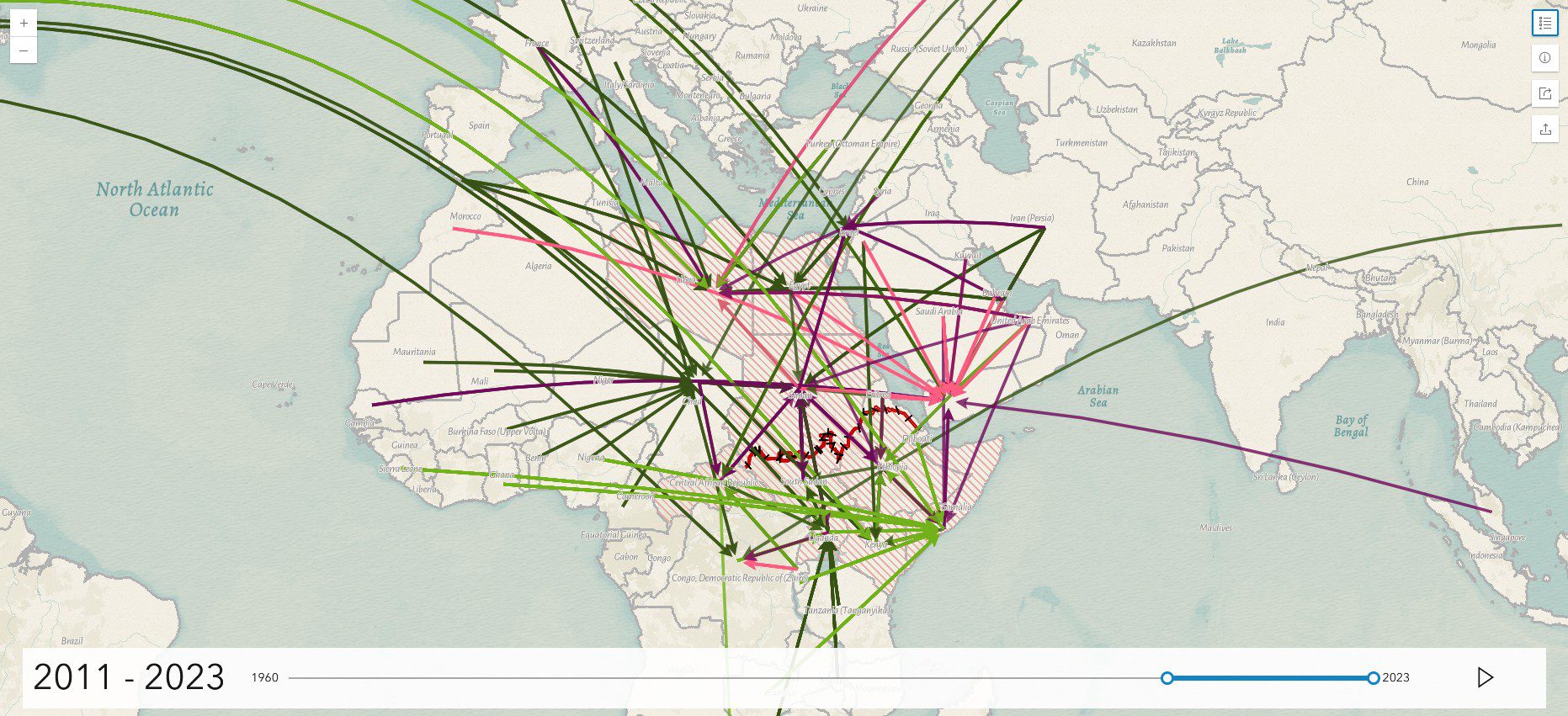
To illustrate this, we developed an interactive map that is available here, which allows users to zoom in on specific regions, click connections to identify source and recipient actors, and explore the timing of support flows, and thereby facilitate a more detailed, less cluttered examination of the data.
Between the 1960s and the late ‘80s, Cold War rivalries and the Arab-Israeli conflict defined external support for insurgents and states in the Horn of Africa. The 90s saw an Islamist regime in Sudan, an independent Eritrean state, and the end of the Cold War, which shifted the nature of external support and alliances in the region. During 2000-2010, amid the global war on terror, Somalia became the epicenter of external involvement through peace operations. Ethiopia, Kenya, and Uganda deployed their troops both unilaterally and under the Blue and Green helmets of the UN and the AU.
Since 2010, conflict in the Horn of Africa has intensified and become more fluid, and its transnational elements have become even more complicated. Five key findings emerge from the update to the TCA for the 2010-23 period.
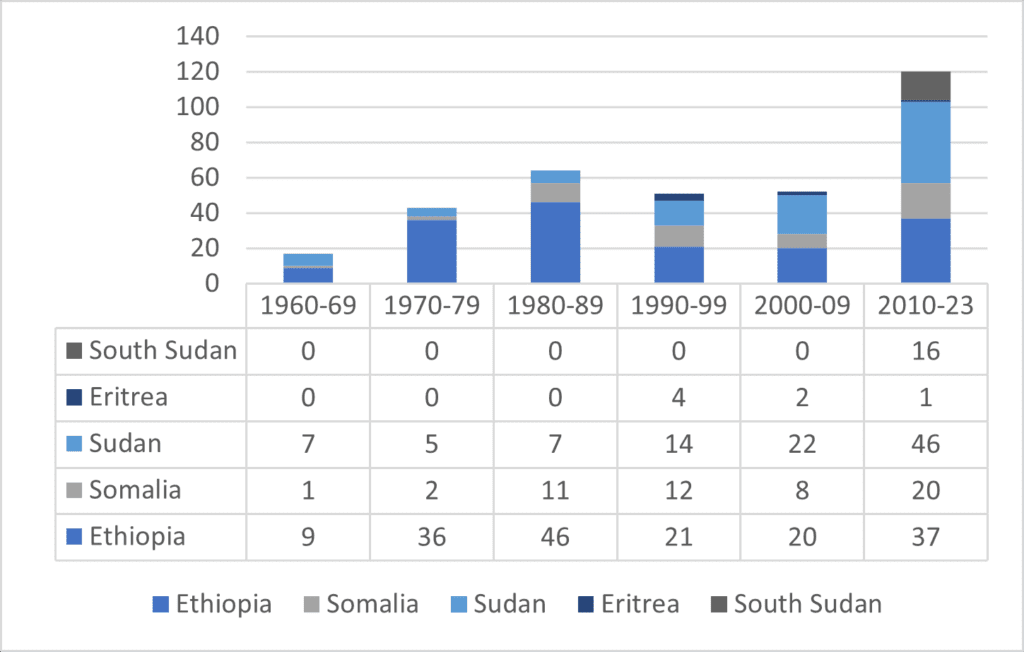
First, the level of transnational armed conflict, already high, further increased During the 2010-23 period, the number of transnational conflicts involving states and non-state armed groups doubled compared to the previous five decades.
Number of Conflict Years Involving Countries of the Horn of Africa as a Primary Party Aggregated in Decades (TCA dataset)
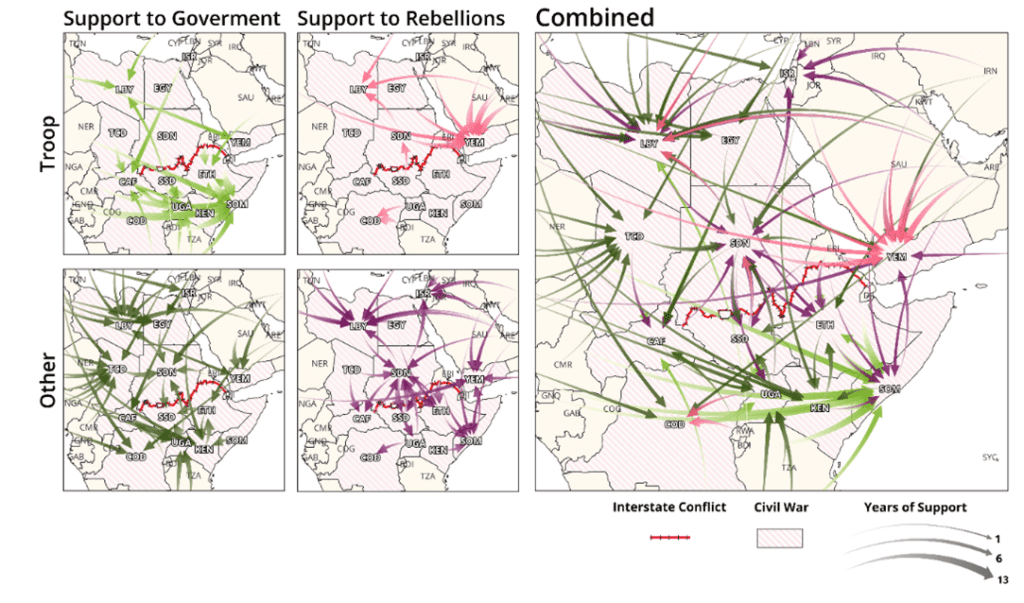
Second – a new factor – states of the Horn provided military support to wars outside their region. Eritrea and Sudan joined the Saudi-led coalition during the Yemen war (2015), providing a military base and contributing combat troops, respectively.
External Conflict Support in the Horn of Africa from 2011 to 2023
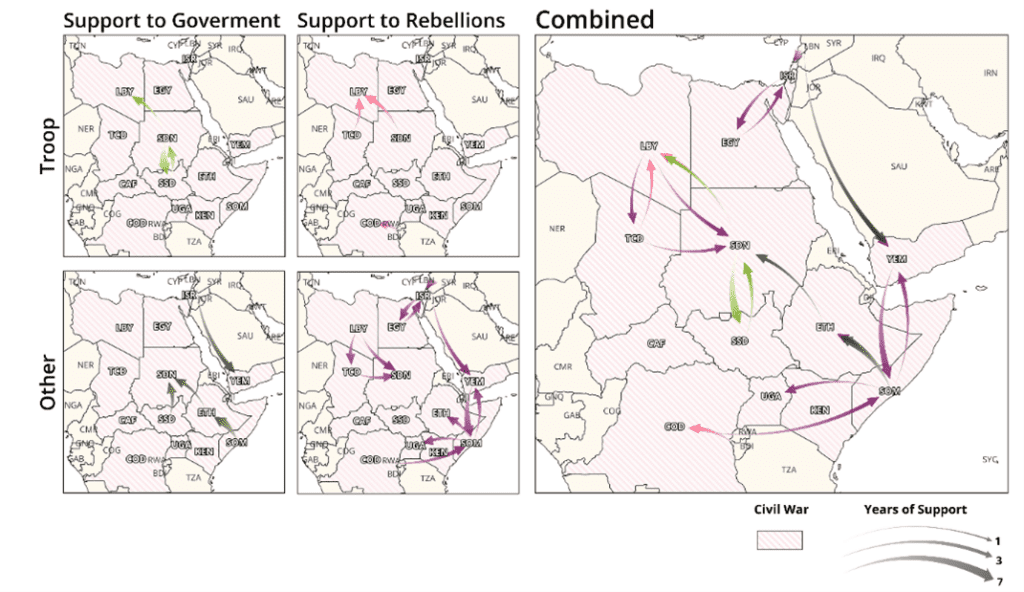
Third, non-state armed groups of the Horn of Africa also increased the cross-border support, usually in the form of ground forces. We see them contributing troops, whether as mercenaries or from political deals, to belligerents in Libya, Sudan, South Sudan, and Yemen.
Non-State Conflict Support in the Horn of Africa Between 2011 and 2023
Fourth, the role of Middle Eastern states in providing external support to conflict parties in the Horn of Africa has hugely increased. After 2010, the data shows a shift in the pattern of sustained activity and direct involvement of the United Arab Emirates, Saudi Arabia, Iran, and Türkiye to both state and non-state actors. There’s an older pattern of Arab states being engaged in the region – what’s new in the last decade and a half is that the main actors are in the Gulf, and the levels of support are far higher than in the past.
Compared to previous decades, external support for conflict and alliance formation in the Horn of Africa became more volatile and fluid. This tracks how multilateral and institutionalized approaches to conflict management gave way to transactional and personalized policies backed by informal arrangements at the leadership level.
Three interrelated developments drove the upsurge in the number of transnational conflicts. First was the independence of South Sudan, which generated new conflicts and amplified the role of non-state armed groups in regional dynamics. Second was the decline of institutionalized security policies in Ethiopia and the collapse of state authority in Sudan. Third was the growing involvement of Middle Eastern powers, which reshaped the region’s political and security landscape.
These dynamics highlight the inadequacy of state-centric frameworks for understanding conflict in the Horn of Africa. Mainly by flattening the role of non-state armed groups, masking hybrid forms of intervention, and obscuring the scale and significance of external support, existing datasets reproduce a picture of conflict that no longer matches realities on the ground.
We identify six major challenges that emerge in this regard:
First, the operationalization of the “State” in conflict datasets obscures the realities of sovereignty, where multiple actors exercise state-like authority simultaneously. The Rapid Support Forces’ occupation of Sudan’s capital, Khartoum, in 2023-24, and the Houthis continuing occupation of Sana’a are cases in point. The question of which actor is to be designated the de facto “state” is contested in both instances.
Second, horizontal conflicts among and between non-state armed groups in the Horn of Africa seldom get recorded. Privileging state–rebel or interstate dyads, datasets struggle to capture multi-layered conflict systems in which rival non-state armed groups fight each other while also receiving support from external states.
Third, state-centric datasets flatten the nature of external involvement, particularly where peacekeeping, counterinsurgency, and unilateral interventions overlap. For example, in Somalia, hybrid deployments by states – simultaneously multilateral and unilateral – are coded uniformly as peace support operations, masking the extent to which they functioned as interventions serving national interests.
Fourth, state-centric datasets have gaps in systematically capturing either scale or strategic weight of external support. In our graphics, we haven’t weighted the lines indicating support, so that crucial, strategic assistance – such as the UAE’s backing of selected clients – is given no greater significance than minor contributions from other actors.
Fifth, state-centric datasets can struggle to account for shifting borders, secessions, and the territorial authority exercised by armed groups in de facto and de jure secessions.
Finally, state-centric datasets face the difficulty of capturing transnational actors that operate outside formal state or armed groups, such as diasporas, transnational business and criminal networks, and private military actors, which often provide financing, logistics, or coercive capacity in conflict.
Therefore, the evidence presented by the TCA calls for more reflexive and empirically grounded approaches to conflict classification – approaches that recognize fragmented sovereignty, fluid alliances, and transnational networks as central to contemporary African wars. For scholars, this means interrogating the assumptions embedded in dominant datasets and investing in methods that can capture complexity without reducing it to static categories. For policymakers, it requires acknowledging that interventions premised on neat interstate or civil war binaries risk misdiagnosing the drivers of instability.
We are grateful for support by Geodiest in creating this visualization.